मराठी
महाराष्ट्र राज्य शिक्षण मंडळएस.एस.सी (इंग्रजी माध्यम) इयत्ता १० वी

Write a Short Note on Dispersion of Light. - Science and Technology 1

Advertisements
Advertisements

प्रश्न

Write a short note on dispersion of light.

Advertisements

उत्तर

Dispersion of light:-

The phenomenon of splitting of light into its component colours is called dispersion of light. When white light passes through a glass prism, it spreads out into a band of different colours which constitute the spectrum of light. The colours in the spectrum of white light are violet, indigo, blue, green, yellow, orange and red. Dispersion takes place because the refractive index of a material such as glass or water is different for different colours. It is maximum for violet colour and minimum for red colour. Hence, in the spectrum of white light obtained with a prism, violet light is deviated the most, while red light is deviated the least. The deviation of light corresponding to other colours lies in between these two colours.

shaalaa.com
  या प्रश्नात किंवा उत्तरात काही त्रुटी आहे का?
2013-2014 (March)

APPEARS IN

संबंधित प्रश्‍न

Explain how spectrum is formed.


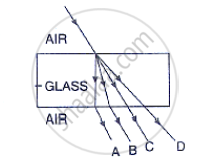
Four students P, Q, R and S traced the path of a ray of light passing through a glass slab for an angle of incidence 40° and measured the angle of refraction. The values as measured them were 18°; 22°; 25° and 30° respectively. The student who has performed the experiment methodically is

(A) P

(B) Q

(C) R

(D) S


If the speed of light in vacuum is 3 × 10⁸ ms−1, find the speed of light in a medium of absolute refractive index 1.5.


The speed of light in glass is 2 × 10⁵ km/s. What is the refractive index of glass?


Draw diagrams to show the refraction of light from glass to air. In  diagram, label the incident ray, refracted ray, the angle of incidence (i) and the angle of refraction (r).


How is the refractive index of a medium related to the speed of light in it? 


A ray of light strikes the surface of a rectangular glass block such that the angle of incidence in
air is  0°.
In each case, draw diagram to show the path taken by the ray as it passes through the glass block and emerges from it. 


In the adjacent diagram, AO is a ray of light incident on a rectangular glass slab.

  1. Complete the path of the ray till it emerges out of the slab.
  2. In the diagram, mark the angle of incidence (i) and the angle of refraction (r) at the first interface. How is the refractive index of glass related to the angles i and r?
  3. Mark angles of emergence by the letter e. How are the angles i and e related?
  4. Which two rays are parallel to each other? Name them.
  5. Indicate in the diagram the lateral displacement between the emergent ray and the incident ray. State one factor that affects the lateral displacement.

With the help of diagram of the principal section of a prism, indicate its refracting surfaces, refracting edge and base. 


A ray of light is passing from a transparent medium 1 to another transparent medium 2 (i) Speed up (ii) slows down. In each case, state whether the refractive index of medium 2 is equal to, less than or greater than the refractive index of medium 1. 


Fill in the blanks to complete the following sentence 

The refractive index of glass with respect to air is 3/2. The refractive index of air with respect to glass will be ………………. 


A student has traced the path of a ray of light through a glass slab as follows. If you are asked to label 1, 2, 3 and 4, the correct sequencing of labeling  ∠i, ∠e, ∠r and lateral displacement respectively is

(a) 2, 1, 3, 4

(b) 1, 2, 3, 4

(c) 1, 3, 2, 4

(d) 1, 3, 4, 2


Which of the following is the best experimental set-up out of the four shown for tracing the path of a ray of light passing through a rectangular glass slab ?


A ray of light falls normally on the surface of a transparent glass slab. Draw a ray diagram to show its path and also mark angle of incidence and angle of emergence.


What is the correct reason for blinking / flickering of stars? Explain it.
a) The blasts in the stars.
b) Absorption of star light by the atmosphere.
c) Motion of the stars.
d) Changing refractive index of gases in the atmosphere.


Name the factors on which the deviation produced by a prism depends.

Can you guess the focal length of a plane mirror?

In the fig., PO is a ray of light incident on a rectangular glass block.
(a)   Complete the path of the ray through the block.
(b)  In the diagram, mark the angle of incidence (i) and the angle of refraction (r) at the first interface. How is the refractive index of glass related to the angles I and r?
(c)  Mark angle of emergence by the letter e. How are the angles i and e related?
(d)  Which two rays are parallel to each other? Name them.
(e)  Indicate in the diagram the lateral displacement between the emergent ray and the incident ray.


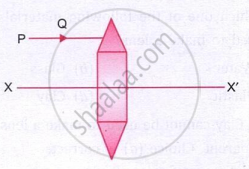
Fig shows a lens as a combination of a glass block and two prisms.
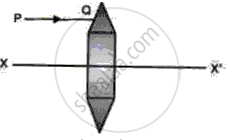
(i) Name the lens formed by the combination.

(ii) What is the line XX' called?

(iii) Complete the path of the incident ray PQ after passing through the lens.

(iv) The final emergent ray either meets XX' at a point or appears to come from a point on XX'. Label it as F, What is this point called?


Which colour of light travels fastest in any medium except air?


A ray of light strikes the surface at a rectangular glass slab such that the angle of incidence is 45o.

In each case, draw diagram to show the path taken by the ray as it passes through the glass slab and emerges from it.


How does the deviation produced by a prism depend on the refraction index of its material.


A total reflecting equilateral prism can be used to deviate a ray of light through:


Why do the faces of persons sitting around campfire appear to shimmer?


Why does a fisherman aim at the tail of fish during spearfishing?


During sunset and sunrise, the sun is seen when it is slightly below the horizon. Give reason.


A ray of monochromatic light is incident from air into a glass slab. Draw a labelled ray diagram indicating the change in its path till it emerges out of the slab. In the diagram, mark the angle of incidence (i) and the angle of refraction (r) at the first interface. How is the refractive index of glass related to the angles i and r?


After a robbery, if a window has been broken, there will be tiny particles of glass. Some of these will be found at the scene of the crime and some may be caught in the thief’s clothing. If the police can prove that these particles are identical, they have a strong case.
A method of doing this is to suspend the particles of glass in a special liquid. Light of a single colour is thrown through the liquid and the particles viewed through a microscope. The temperature of the liquid is then slowly altered. This alters the speed of light through the liquid (i.e., it alters the refractive index). At one particular temperature, the particles of glass disappear. It this happens at the same temperature for both sets of glass particles, they probably came from the same broken pane of glass.
Complete and copy the diagram to show how light bends when it travels from the liquid to the glass and back to the liquid, If the light slows down in the glass.


Complete the ray diagram showing its emergence into the air after passing through the prism.


Light passes through a rectangular glass slab and through a triangular glass prism. In what way does the direction of the two emergent beams differ and why?


How will you verify the laws of refraction or how the refractive index of glass is determined in the laboratory?


Trace a ray of light incident at 30° on a surface if travelling from air to glass. What is the angle of refraction in this case? (R.I. for glass = 3/2).


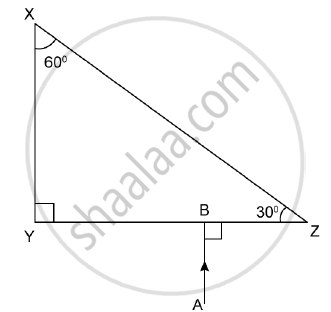
A ray of light PQ is incident normally on the hypotenuse of a right-angled prism ABC as shown in the diagram given below:

(i) Copy the diagram and complete the path of the ray PQ till it emerges from the prism.
(ii) What is the value of the angle of deviation of the ray?
(iii) Name an instrument where this action of the prism is used.


Write the approximate values of speed of light in (i) air and (ii) glass. Use these values to calculate the refractive index of glass with respect to air.


The refractive index of glass with respect to air is 1.5. What is the value of the refractive index of air with respect to glass?


A ray of light is incident at an angle of 45° on one face of a rectangular glass slab of thickness 10 cm and refractive index 3/2. Calculate the lateral shift produced ______.


Observe the figure and name the ray AB, ray CD, ray GH.


The diagram below shows two parallel rays A (Orange) & B (Blue) incident from air, on air-glass boundary.

  1. Copy and complete the path of the rays A and B.
  2. How do the speeds of these rays differ in glass?
  3. Are the two refracted rays in glass parallel? Give a reason.

Share
Notifications

Englishहिंदीमराठी


      Forgot password?
Use app×