Advertisements
Advertisements
प्रश्न
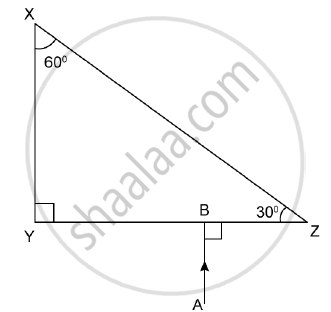
The following diagram shows a 60°, 30°, 90° glass prism of critical angle 42°, Copy the diagram and complete the path of incident ray AB emerging out of the prism marking the angle of incidence on each surface.
Advertisements
उत्तर

APPEARS IN
संबंधित प्रश्न
If the speed of light in vacuum is 3 × 10⁸ ms−1, find the speed of light in a medium of absolute refractive index 1.5.
State the dependence of angle of deviation on the refractive index of the material of the prism.
Draw the diagram of refraction of light in the glass slab
A light ray in passing from water to a medium
(a) speeds up
(b) slows down. In each case, give one example of the medium.
A ray of light passes from air to water. In fig., which of the ray A, B, C and D is the correct refracted ray?
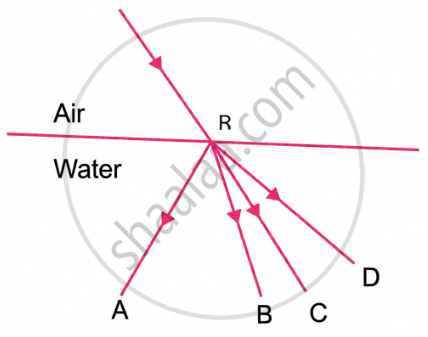
Fig shows a lens as a combination of a glass block and two prisms.
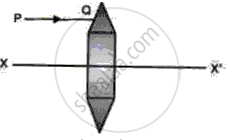
(i) Name the lens formed by the combination.
(ii) what is the XX' called?
(iii) Complete the ray diagram and show the path of the incident ray PQ after passing through the lens.
(iv) The final emergent ray will either meet XX' at a point or appear to come from a point on XX'. what is the point called?
Draw a ray diagram showing the lateral displacement of a ray of light when it passes through a parallel sided glass slab.
State the relation between the refractive index μ and the velocity of light (vm) in that medium.
Draw ray of light bending towards the normal while passing from air to glass. Label your diagrams.
