Advertisements
Advertisements
प्रश्न
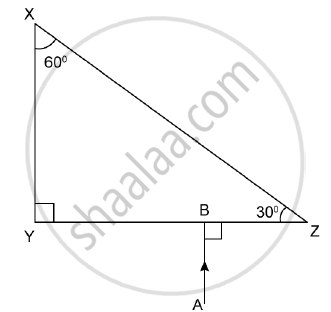
The following diagram shows a 60°, 30°, 90° glass prism of critical angle 42°, Copy the diagram and complete the path of incident ray AB emerging out of the prism marking the angle of incidence on each surface.
Advertisements
उत्तर

APPEARS IN
संबंधित प्रश्न
When a ray of light from air enters a denser medium, it ______.
A student has traced the path of a ray of light through a glass slab as follows. If you are asked to label 1, 2, 3 and 4, the correct sequencing of labeling ∠i, ∠e, ∠r and lateral displacement respectively is
(a) 2, 1, 3, 4
(b) 1, 2, 3, 4
(c) 1, 3, 2, 4
(d) 1, 3, 4, 2
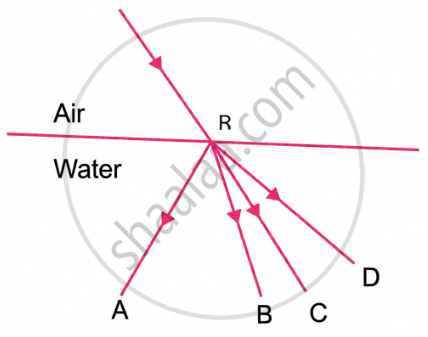
A ray of light passes from air to water. In fig., which of the ray A, B, C and D is the correct refracted ray?
What is meant by the refraction of light?
Which colour of light travels fastest in any medium except air?
What is the refractive index of vacuum
In what condition a prism is said to be in the position of minimum deviation? What is the direction of the refracted ray inside the prism in this condition?
Complete the ray diagram showing its emergence into the air after passing through the prism.

Draw the ray diagram of a glass slab having medium A and B for the velocity of light ray VA and VB respectively and define Snell's law.
- If VB = 1.5 VA, then which medium is denser?
- What is the refractive index of A with respect to B?
- What is the refractive index of B with respect to A?
