Advertisements
Advertisements
प्रश्न
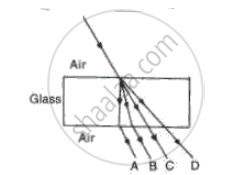
In the fig. name the ray which represents the correct path of light while passing through a glass block.
Advertisements
उत्तर
The correct path is that of ray 'B'.
APPEARS IN
संबंधित प्रश्न
Define refraction and state the laws of refraction.
If the speed of light in vacuum is 3 × 10⁸ ms−1, find the speed of light in a medium of absolute refractive index 1.5.
Explain the term absolute refractive index of a medium and write an expression to relate it with the speed of light in vacuum.
Draw a ray diagram to show the refraction of a monochromatic ray through a prism when it suffers minimum deviation.
Which of the above wavelengths has a higher frequency?
Draw diagrams to show the refraction of light from
- air to glass, and
- glass to air. In each diagram, label the incident ray, refracted ray, the angle of incidence
- and the angle of refraction (r).
Why upper surface of water contained in a beaker and above eye level appears silvery?
In what condition a prism is said to be in the position of minimum deviation? What is the direction of the refracted ray inside the prism in this condition?
The diagram below shows two parallel rays A (Orange) & B (Blue) incident from air, on air-glass boundary.

- Copy and complete the path of the rays A and B.
- How do the speeds of these rays differ in glass?
- Are the two refracted rays in glass parallel? Give a reason.
