Advertisements
Advertisements
प्रश्न
Define refraction and state the laws of refraction.
Advertisements
उत्तर
The phenomenon of change in the direction of propagation of light when it passes obliquely from one transparent medium to another is called refraction of light.
Laws of refraction:-
- The incident ray and the refracted ray are on the opposite sides of the normal at the point of incidence, and all three lie in the same plane.
- For a given pair of media, the ratio of the sine of the angle of incidence to the sine of the angle of refraction is constant.
`sin i/sin r=mu`
This constant is called the refractive index of the second medium with respect to the first medium.
APPEARS IN
संबंधित प्रश्न
Study the following four experimental set-ups I, II, III and IV for the experiment, "To trace the path of a ray of light through a rectangular glass slab."

Which of the marked set-ups is likely to give best results (P1 and P2 are the positions of pins fixed on the incident ray)?
(A) I
(B) II
(C) III
(D) IV
How does the angle of deviation produced by a prism change with increase in the angle of incidence. Draw a curve showing the variation in the angle of deviation with the angle of incidence at a prism surface.
How does the speed of light change when it passes from glass to water?
A coin is places at the bottom of a beaker containing water (refractive index = 4/3) to a depth of 12 cm. By what height the coin appears to be raised when seen from vertically above?
A postage stamp kept below a rectangular glass block of refractive index 1.5 when viewed from vertically above it, appears to be raised by 7.0 mm. Calculate the thickness of the glass slab.
Select from the following the best experimental set-up for tracing the path of a ray of light through a glass slab: (A) I
(A) I
(B) II
(C) III
(D) IV
While tracing the path of a ray of light passing through a rectangular glass slab a student tabulated his observations as given below:
|
S.NO. |
∠i |
∠r |
∠e |
|
I |
60° |
40° |
61° |
|
II |
50° |
36° |
51° |
|
III |
40° |
28° |
39° |
|
IV |
30° |
20° |
31° |
The correct observations is:
(A) I
(B) II
(C) III
(D) IV
Draw an í- `delta` graph for a mono chromatic raY through a glass prism of a plane and mark
(i) `delta` m, the angle of mínimum devíation
(íí) Any two values of i for which value of `delta` ís same.
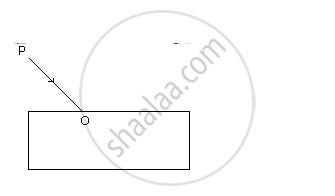
In the fig., PO is a ray of light incident on a rectangular glass block.
(a) Complete the path of the ray through the block.
(b) In the diagram, mark the angle of incidence (i) and the angle of refraction (r) at the first interface. How is the refractive index of glass related to the angles I and r?
(c) Mark angle of emergence by the letter e. How are the angles i and e related?
(d) Which two rays are parallel to each other? Name them.
(e) Indicate in the diagram the lateral displacement between the emergent ray and the incident ray.
Light of a single colour is passed through a liquid having a piece of glass suspended in it. On changing the temperature of liquid, at a particular temperature, the glass piece is not seen.
Why is the light of a single colour used ?
A ray of light passes from water to air. How does the speed of light change?
Does the depth of a tank of water appear to change or remain the same when viewed normally from above?
How does the angle of deviation produced by a prism depend on the colour of light used? Which colour of white light is deviated (i) most, (ii) least, by a prism?
In the diagram below, PQ is a ray of light incident on a rectangular glass block.

Copy the diagram and complete the path of the ray of light through the glass block. In your diagram, mark the angle of incidence by letter ‘i’ and the angle of emergence by the letter ‘e’.
In the diagram alongside a ray of light, PQ is incident normally on one face AB of an equilateral glass prism. What is the angle of incidence at the faces AB and AC?

Explain with the help of a diagram of how fish is able to see the objects above it.
The velocity of light in diamond is 121000 kms-1. What is its refractive index?
A glass block is having refractive index 3/2, the light ray is incident at an angle 45°. Find the sine of the angle of, refraction inside the glass block.
