Advertisements
Advertisements
प्रश्न
Define the absolute refractive index.
Define absolute refractive index of an optical medium.
Advertisements
उत्तर
APPEARS IN
संबंधित प्रश्न
Explain how the formation of a rainbow occurs.
Four students P, Q, R and S traced the path of a ray of light passing through a glass slab for an angle of incidence 40° and measured the angle of refraction. The values as measured them were 18°; 22°; 25° and 30° respectively. The student who has performed the experiment methodically is
(A) P
(B) Q
(C) R
(D) S
A ray of light passes from glass into air. The angle of refraction will be:
(a) equal to the angle of incidence
(b) greater than the angle of incidence
(c) smaller than the angle of incidence
(d) 45°
The highest refractive index is of ______.
A ray of light of wavelength 6600 Å suffer refraction from air to glass. Taking \[\ce{_a\mu_g = \frac{3}{2}}\], find the wavelength of light in glass.
The diagram alongside shows the refraction of a ray of light from air to a liquid.
- Write the values of (i) angle of incidence, (ii) angle of refraction.
- Use Snell’s law to find the refractive index of liquid with respect to air.

A ray of light falls normally on the surface of a transparent glass slab. Draw a ray diagram to show its path and also mark angle of incidence and angle of emergence.
While tracing the path of a ray of light passing through a rectangular glass slab a student tabulated his observations as given below:
|
S.NO. |
∠i |
∠r |
∠e |
|
I |
60° |
40° |
61° |
|
II |
50° |
36° |
51° |
|
III |
40° |
28° |
39° |
|
IV |
30° |
20° |
31° |
The correct observations is:
(A) I
(B) II
(C) III
(D) IV
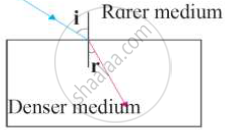
Observe the figure and write accurate conclusion regarding refraction of light.
In the fig. name the ray which represents the correct path of light while passing through a glass block.
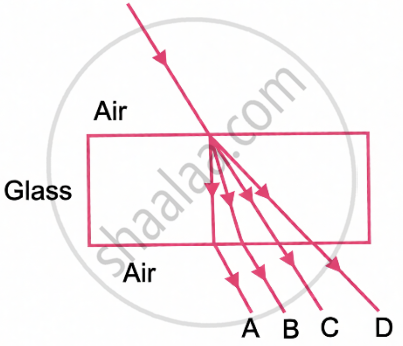
Fig shows a lens as a combination of a glass block and two prisms.
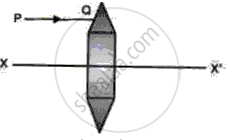
(i) Name the lens formed by the combination.
(ii) what is the XX' called?
(iii) Complete the ray diagram and show the path of the incident ray PQ after passing through the lens.
(iv) The final emergent ray will either meet XX' at a point or appear to come from a point on XX'. what is the point called?
Rewrite the following statement by selecting the correct option:
If a ray of light strikes a glass slab at an angle of 600 with the surface of the slab, the angle of incidence must be __________________.
Which colour of light travels fastest in any medium except air?
Can the absolute refractive index of a medium be less than one?
A ray of monochromatic light is incident from air into a glass slab. Draw a labelled ray diagram indicating the change in its path till it emerges out of the slab. In the diagram, mark the angle of incidence (i) and the angle of refraction (r) at the first interface. How is the refractive index of glass related to the angles i and r?
The diagram shows the path of a ray of light through a rectangular glass block placed in a liquid of uniform density.

(a) Does the light speed up or slow down in the glass,
(b) Give the reason for your answer.
Draw a diagram of a prism and label:
(i) the base,
(ii) the refracting surfaces,
(iii) the refracting edge,
(iv) the refracting angle in it.
