Advertisements
Advertisements
प्रश्न
Can the absolute refractive index of a medium be less than one?
Can the value of the absolute refractive index be lesser than 1?
Advertisements
उत्तर
No, the absolute refractive index of a medium cannot be less than one because the speed of light in any medium is always less than that in a vacuum.
APPEARS IN
संबंधित प्रश्न
Draw a ray diagram to show the refraction of a monochromatic ray through a prism when it suffers minimum deviation.
Name one factor that affects the lateral displacement of light as it passes through a rectangular glass slab.
Name a prism required for obtaining a spectrum of Ultraviolet light.
How is the reflection of light ray from a plane mirror different from the refraction of light ray as it enters a block of glass?
How is the refractive index of a medium related to the speed of light in it?
When a lighted candle is held in front of a thick plane glass mirror, several images can be seen, but the second image is the brightest, give reason.
When a ray of light from air enters a denser medium, it ______.
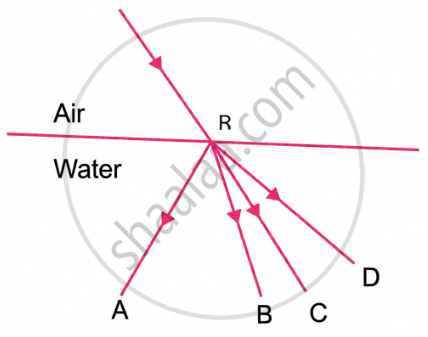
A ray of light passes from air to water. In fig., which of the ray A, B, C and D is the correct refracted ray?
Light of a single colour is passed through a liquid having a piece of glass suspended in it. On changing the temperature of liquid, at a particular temperature, the glass piece is not seen.
Why is the light of a single colour used ?
Draw a ray diagram showing the lateral displacement of a ray of light when it passes through a parallel sided glass slab.
Why upper surface of water contained in a beaker and above eye level appears silvery?
The refractive index of air with respect to glass is defined: as gµa = sin i/sin r
If r = 90°, what is the corresponding angle i called?
In the diagram below, PQ is a ray of light incident on a rectangular glass block.

Copy the diagram and complete the path of the ray of light through the glass block. In your diagram, mark the angle of incidence by letter ‘i’ and the angle of emergence by the letter ‘e’.
Draw ray of light bending towards the normal while passing from air to glass. Label your diagrams.
The diagram shows the path of a ray of light through a rectangular glass block placed in a liquid of uniform density.

Show with the help of a ray diagram the path of the ray when incident ray normally falls on the first surface of the glass block and passes through the block and the liquid.
Explain with the help of a diagram of how fish is able to see the objects above it.
A ray of light PQ is incident normally on the hypotenuse of a right-angled prism ABC as shown in the diagram given below:

(i) Copy the diagram and complete the path of the ray PQ till it emerges from the prism.
(ii) What is the value of the angle of deviation of the ray?
(iii) Name an instrument where this action of the prism is used.
The diagram below shows two parallel rays A (Orange) & B (Blue) incident from air, on air-glass boundary.

- Copy and complete the path of the rays A and B.
- How do the speeds of these rays differ in glass?
- Are the two refracted rays in glass parallel? Give a reason.
