Advertisements
Advertisements
प्रश्न
Explain with the help of a diagram of how fish is able to see the objects above it.
Advertisements
उत्तर
A fish can see everything above it in clear water irrespective of its position in different depths. The critical angle for water is 48.5°. The angle of the cone of vision for the fish is twice this angle.

Hence it is 97°. All the objects outside water but in this cone of vision Will be seen by the fish. Outside this range, the fish will see all the objects in the surrounding area (see figure). Those objects which are at the bottom will be seen by the fish due to total internal reflection taking place at the water-air interface.
संबंधित प्रश्न
Write a relationship between the angle of incidence and angle of refractions for a given pair of media.
Which of the above wavelengths has a higher frequency?
A student has traced the path of a ray of light through a glass slab as follows. If you are asked to label 1, 2, 3 and 4, the correct sequencing of labeling ∠i, ∠e, ∠r and lateral displacement respectively is
(a) 2, 1, 3, 4
(b) 1, 2, 3, 4
(c) 1, 3, 2, 4
(d) 1, 3, 4, 2
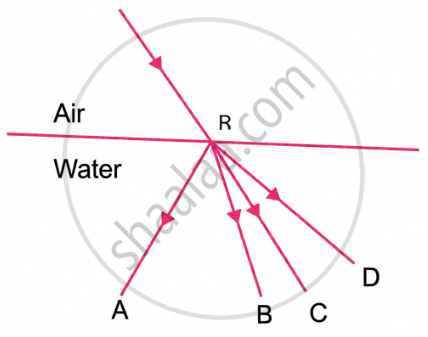
A ray of light passes from air to water. In fig., which of the ray A, B, C and D is the correct refracted ray?
A ray of light strikes the surface at a rectangular glass slab such that the angle of incidence is 45o.
In each case, draw diagram to show the path taken by the ray as it passes through the glass slab and emerges from it.
A total reflecting equilateral prism can be used to deviate a ray of light through:
Rewrite the following statement by selecting the correct option:
If a ray of light strikes a glass slab at an angle of 600 with the surface of the slab, the angle of incidence must be __________________.
Can the absolute refractive index of a medium be less than one?
What is the total reflecting prism?
A ray of light is incident at an angle of 45° on one face of a rectangular glass slab of thickness 10 cm and refractive index 3/2. Calculate the lateral shift produced ______.
