Advertisements
Advertisements
प्रश्न
The speed of light in air is 3 × 10⁸ ms-1. Calculate the speed of light in water. The refractive index of water is 4/3.
Advertisements
उत्तर
The refractive index of water `="Speed of light in air"/"Speed of light in water"`
∴ Speed of light in water `="Speed of light in air"/"Refractive index of water"`
= `(3xx10^8)/(4//3)`
= 2.25 × 10⁸ ms−1.
संबंधित प्रश्न
A student traces the path of a ray of light through a rectangular glass slab for the different values of angle of incidence. He observes all possible precautions at each step of the experiment. At the end of the experiment, on analyzing the measurements, which of the following conclusions is he likely to draw?
(A) ∠i = ∠e < ∠r
(B) ∠i < ∠e < ∠r
(C) ∠i > ∠e > ∠r
(D) ∠i = ∠e > ∠r
Four students P, Q, R and S traced the path of a ray of light passing through a glass slab for an angle of incidence 40° and measured the angle of refraction. The values as measured them were 18°; 22°; 25° and 30° respectively. The student who has performed the experiment methodically is
(A) P
(B) Q
(C) R
(D) S
Why do we get a spectrum of seven colors when white light is dispersed by a prism?
Light passes through a rectangular glass slab and through a triangular glass prism. In what way does the direction of the two emergent beams differ and why?
An object is viewed through a glass prism with its vertex pointing upwards. It appears to be displaced upward. Explain the reason.
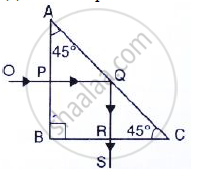
A ray of light OP passes through a right angles prism as shown in the adjacent diagram.
(a) State the angles of incidence at the faces AC and BC.
(b) Name the phenomenon which the ray suffers at the face AC.
Observe the figure and write accurate conclusion regarding refraction of light.
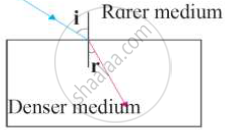
Can the absolute refractive index of a medium be less than one?
A glass block is having refractive index 3/2, the light ray is incident at an angle 45°. Find the sine of the angle of, refraction inside the glass block.
Consider these indices of refraction: glass: 1.52; air: 1.0003; water: 1.333. Based on the refractive indices of three materials, arrange the speed of light through them in decreasing order.
