Advertisements
Advertisements
प्रश्न
A ray of monochromatic light is incident from the air on a glass slab:
(i) Draw a labelled ray diagram showing the change in the path of the ray till it emerges from the glass slab.
(ii) Name the two rays that are parallel to each other.
(iii) Mark the lateral displacement in your diagram.
Advertisements
उत्तर
(i) Ray diagram of monochromatic light

(ii) Incident ray and emergent rays are parallel to each other.
(iii) Lateral displacement is marked by d in the diagram.
APPEARS IN
संबंधित प्रश्न
After tracing the path of a ray of light passing through a rectangular glass slab for four different values of the angle of incidence, a student reported his observations in tabular form as given below:
| S.No | ∠ i | ∠ r | ∠ e |
| I | 30° | 19° | 29° |
| II | 40° | 28° | 40° |
| III | 50° | 36° | 50° |
| IV | 60° | 40° | 59° |
The best observation is
(A) I
(B) II
(C) III
(D) IV
A total reflecting right angled isosceles prism can be used to deviate a ray of light through:
(a) 30° (b) 60° (c) 75° (d) 90°.
Select from the following the best set-up for tracing the path of a ray of light through a rectangular glass slab:

(A) I
(B) II
(C) III
(D) IV
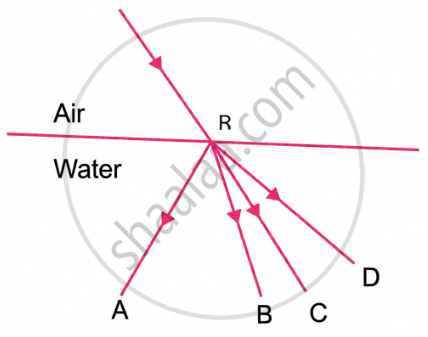
A ray of light passes from air to water. In fig., which of the ray A, B, C and D is the correct refracted ray?
Using the curve, how do you infer that for given prism, the angle of minimum deviation δmin is unique for the given light?
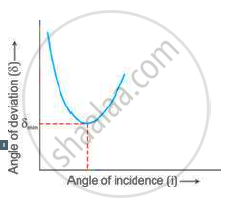
How does the deviation produced by a prism depend on the wavelength of incident light?
During sunset and sunrise, the sun is seen when it is slightly below the horizon. Give reason.
What is the refractive index of water
Name two instruments of the total refracting prism in which is used.
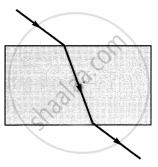
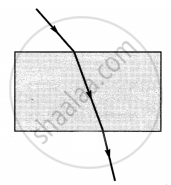
The path of a ray of light coming from air passing through a rectangular glass slab traced by four students are shown as A, B, C and D in the figure. Which one of them is correct?
 |
 |
 |
 |
| A | B | C | D |
