Advertisements
Advertisements
प्रश्न
How does the deviation produced by a prism depend on the wavelength of incident light?
Advertisements
उत्तर
The refractive index of a medium is different for light of different colours. It increases with decrease in wavelength. Thus, the refractive index of the material of prism is maximum for violet and least for red light. Hence, the prism deviates violet light the most and red light the least, i.e., δviolet > δred
APPEARS IN
संबंधित प्रश्न
A student traces the path of a ray of light passing through a rectangular glass slab and marks the angle of incidence i, angle of refraction r and angle of emergence e, as shown.
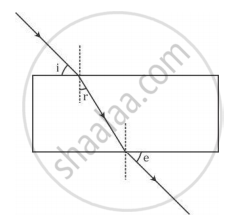
The correctly marked angle(s) is/are
(A) ∠ i only
(B) ∠ e only
(C) ∠ r only
(D) ∠ i and ∠ e
How can you bend light away from the normal?
Which of the following is the best experimental set-up out of the four shown for tracing the path of a ray of light passing through a rectangular glass slab ?
Make the correct for each of the following :
With reference to the fig, the refractive index of the glass block is
A total reflecting equilateral prism can be used to deviate a ray of light through:
What is the refractive index of vacuum
What do you understand by the deviation produced by a prism?
You are provided with a printed piece of paper. Using this paper how will you differentiate between a convex lens and a concave lens?
Observe the figure and name the ray AB, ray CD, ray GH.

Which colour of white light travels fastest in any medium except air?
