Advertisements
Advertisements
प्रश्न
In the diagram below, PQ is a ray of light incident on a rectangular glass block.

How are the angles ‘i’ and ‘e’ related to each other?
Advertisements
उत्तर
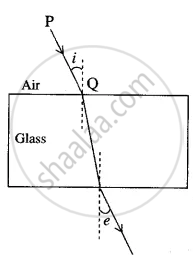
When the incident ray is undergoing minimum deviation the angle of incidence is equal to the angle of emergence, i.e., ∠i – ∠e
संबंधित प्रश्न
Select from the following the best experimental setup for tracing the path of a ray of light passing through a rectangular glass slab.
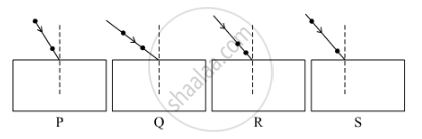
(a) P
(b) Q
(c) R
(d) S
How does the angle of minimum deviation produces by a prism change with increase in :
the wavelength of incident light
During sunset and sunrise, the sun is seen when it is slightly below the horizon. Give reason.
What is the refractive index of vacuum
Can the absolute refractive index of a medium be less than one?
Draw ray of light bending towards the normal while passing from glass to water. Label your diagrams.
How will you verify the laws of refraction or how the refractive index of glass is determined in the laboratory?
The refractive index of glass with respect to air is 3/2. What is the refractive index of air with respect to glass?
