Advertisements
Advertisements
प्रश्न
Trace a ray of light incident at 30° on a surface if travelling from glass to air. What is the angle of refraction in this case? (R.I. for glass = 3/2).
Advertisements
उत्तर
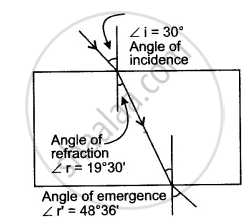
For a ray of light from glass to air R.I. is denoted as gμa.
`""_"g"mu_"a"=1/(""_"a"mu_"g")`
∴ `sin"i"/sin"r′"=1/(""_"a"mu_"g")`
sin r′ = aμg × sin i
and aμg = `3/2`
∴ sin r′ = `3/2xx1/2`
= `3/4`
= 0.7500
∴ r′ = 48°36′
Angle of refraction for glass to air = 48°36′.
संबंधित प्रश्न
Draw the diagram of refraction of light in the glass slab
Draw diagrams to show the refraction of light from glass to air. In diagram, label the incident ray, refracted ray, the angle of incidence (i) and the angle of refraction (r).
When a lighted candle is held in front of a thick plane glass mirror, several images can be seen, but the second image is the brightest, give reason.
The refractive index of air with respect to glass is expressed as `""_g μ_a=sin i /sin r`.
- Write down a similar expression for aμg in terms of the angles i and r.
- If angle r = 90°, what is the corresponding angle i called?
- What is the physical significance of the angle i in part (b)?
A total reflecting right angled isosceles prism can be used to deviate a ray of light through:
(a) 30° (b) 60° (c) 75° (d) 90°.
A glass slab is placed over a page on which the word VIBGYOR is printed with each letter in its corresponding colour.
- Will the image of all the letters be in the same place?
- If not, the state which letter will be raised to the maximum. Give a reason for your answer.
How does the angle of deviation produced by a prism depend on the colour of light used? Which colour of white light is deviated (i) most, (ii) least, by a prism?
The diagram shows the path of a ray of light through a rectangular glass block placed in a liquid of uniform density.

(a) Does the light speed up or slow down in the glass,
(b) Give the reason for your answer.
What is lateral displacement?
