Advertisements
Advertisements
प्रश्न
Trace a ray of light incident at 30° on a surface if travelling from glass to air. What is the angle of refraction in this case? (R.I. for glass = 3/2).
Advertisements
उत्तर
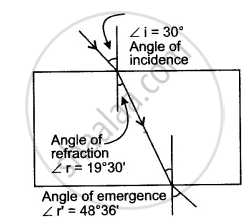
For a ray of light from glass to air R.I. is denoted as gμa.
`""_"g"mu_"a"=1/(""_"a"mu_"g")`
∴ `sin"i"/sin"r′"=1/(""_"a"mu_"g")`
sin r′ = aμg × sin i
and aμg = `3/2`
∴ sin r′ = `3/2xx1/2`
= `3/4`
= 0.7500
∴ r′ = 48°36′
Angle of refraction for glass to air = 48°36′.
संबंधित प्रश्न
Study the following four experimental set-ups I, II, III and IV for the experiment, "To trace the path of a ray of light through a rectangular glass slab."

Which of the marked set-ups is likely to give best results (P1 and P2 are the positions of pins fixed on the incident ray)?
(A) I
(B) II
(C) III
(D) IV
On the basis of the experiment, "To trace the path of a ray of light through a rectangular glass slab", students of a class arrived at which one of the following conclusions?
(A) Angle of incidence is greater than the angle of emergence.
(B) Angle of emergence is smaller than the angle of refraction.
(C) Emergent ray is parallel to the refracted ray.
(D) Incident ray and emergent ray are parallel to each other.
How is the reflection of light ray from a plane mirror different from the refraction of light ray as it enters a block of glass?
How can you bend light away from the normal?
How must light travel out of a substance if it is not going to be refracted?
With the help of diagram of the principal section of a prism, indicate its refracting surfaces, refracting edge and base.
A pond appears to be 2.7 m deep. If the refractive index of water is `4/3`, find the actual depth of the pond.
Name the phenomenon responsible in the following case:
Apparent bending of a stick in water
Why do the faces of persons sitting around campfire appear to shimmer?
