Advertisements
Advertisements
Question
Trace a ray of light incident at 30° on a surface if travelling from glass to air. What is the angle of refraction in this case? (R.I. for glass = 3/2).
Advertisements
Solution
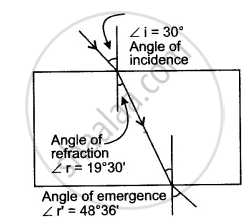
For a ray of light from glass to air R.I. is denoted as gμa.
`""_"g"mu_"a"=1/(""_"a"mu_"g")`
∴ `sin"i"/sin"r′"=1/(""_"a"mu_"g")`
sin r′ = aμg × sin i
and aμg = `3/2`
∴ sin r′ = `3/2xx1/2`
= `3/4`
= 0.7500
∴ r′ = 48°36′
Angle of refraction for glass to air = 48°36′.
RELATED QUESTIONS
Study the following four experimental set-ups I, II, III and IV for the experiment, "To trace the path of a ray of light through a rectangular glass slab."

Which of the marked set-ups is likely to give best results (P1 and P2 are the positions of pins fixed on the incident ray)?
(A) I
(B) II
(C) III
(D) IV
Draw a ray diagram to show the refraction of a monochromatic ray through a prism when it suffers minimum deviation.
State the dependence of angle of deviation on the refractive index of the material of the prism.
Which colour of light travels fastest in any medium except air?
Draw the diagram of refraction of light in the glass slab
Select from the following the best experimental set-up for tracing the path of a ray of light through a glass slab: (A) I
(A) I
(B) II
(C) III
(D) IV
Fill in the blank to complete the following sentence:
When light travels from a rarer to a denser medium, it bends ...........
What should be the ratio of the speed of light through the liquid to the speed through the glass so that there is no refraction of light at the boundaries of the glass block when the system is illuminated by the light of one colour?
Draw ray of light bending towards the normal while passing from air to glass. Label your diagrams.
