Advertisements
Advertisements
Question
Advertisements
Solution
Two advantages of using total reflecting prism as a reflector in place of a plane mirror are:
(i) When total internal reflection occurs, the entire light (100%) is reflected back into the denser medium, whereas in ordinary reflection from plane mirror, some light is refracted or absorbed (i.e. reflection is partial).
(ii) Total reflecting prism gives a much brighter image than that obtained by using the plane mirror.
APPEARS IN
RELATED QUESTIONS
Explain how spectrum is formed.
Draw diagrams to show the refraction of light from glass to air. In diagram, label the incident ray, refracted ray, the angle of incidence (i) and the angle of refraction (r).
How is the refractive index of a medium related to the speed of light in it?
A light ray in passing from water to a medium
(a) speeds up
(b) slows down. In each case, give one example of the medium.
A student has traced the path of a ray of light through a glass slab as follows. If you are asked to label 1, 2, 3 and 4, the correct sequencing of labeling ∠i, ∠e, ∠r and lateral displacement respectively is
(a) 2, 1, 3, 4
(b) 1, 2, 3, 4
(c) 1, 3, 2, 4
(d) 1, 3, 4, 2
Make the correct for each of the following :
With reference to the fig, the refractive index of the glass block is
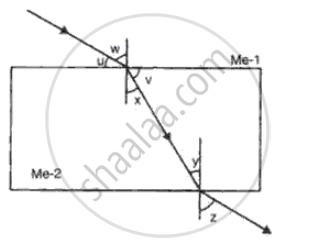
During sunset and sunrise, the sun is seen when it is slightly below the horizon. Give reason.
Explain briefly what causes the twinkling of stars at night.
Draw ray of light bending towards the normal while passing from glass to water. Label your diagrams.
