English
Maharashtra State BoardSSC (English Medium) 10th Standard

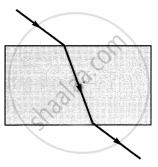
Draw the Diagram of Refraction of Light in Glass Slab - Science and Technology 1

Advertisements
Advertisements

Question

Draw the diagram of refraction of light in the glass slab

Advertisements

Solution

shaalaa.com
  Is there an error in this question or solution?
2017-2018 (March)

RELATED QUESTIONS

Choose the correct alternative and rewrite the following sentence.

A ray of light strikes the glass slab at an angle of 50°. What is the angle of incidence?


A student traces the path of a ray of light passing through a rectangular glass slab and marks the angle of incidence i, angle of refraction r and angle of emergence e, as shown.

The correctly marked angle(s) is/are

(A) ∠ i only

(B) ∠ e only

(C) ∠ r only

(D) ∠ i and ∠ e


A student very cautiously traces the path of a ray through a glass slab for different values of the angle of incidence (∠i). He then measures the corresponding values of the angle of refraction (∠r) and the angle of emergence (∠e) for every value of the angle of incidence. On analysing these measurements of angles, his conclusion would be

(A) ∠i > ∠r  > ∠e

(B) ∠i = ∠e  > ∠r

(C) ∠i < ∠r  < ∠e

(D) ∠i = ∠e  < ∠r


The speed of light in glass is 2 × 10⁵ km/s. What is the refractive index of glass?


Light passes through a rectangular glass slab and through a triangular glass prism. In what way does the direction of the two emergent beams differ and why?


Observe the following figure and answer the questions given under it:

1) How many times does refraction take place in the above figure?

2) What happens to the ray of light when it passes from air to glass?

3) What happens to the ray of light when it passes from glass to air?

4) What are the rays AB and CD in the figure called?

5) Define refraction.


 How can you bend light away from the normal?


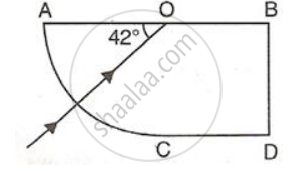
In the adjacent diagram, AO is a ray of light incident on a rectangular glass slab.

  1. Complete the path of the ray till it emerges out of the slab.
  2. In the diagram, mark the angle of incidence (i) and the angle of refraction (r) at the first interface. How is the refractive index of glass related to the angles i and r?
  3. Mark angles of emergence by the letter e. How are the angles i and e related?
  4. Which two rays are parallel to each other? Name them.
  5. Indicate in the diagram the lateral displacement between the emergent ray and the incident ray. State one factor that affects the lateral displacement.

When light travels from a rarer to a denser medium, its speed ______.


In fig 4.18, name the ray which represents the correct path of light while emerging out through a glass block. 


How is the angle of emergence related to the angle of incidence when prism is in the position of minimum deviation? Illustrate your answer with help of a labelled diagram using an equilateral prism? 


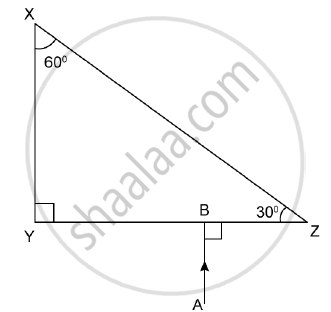
Fig 4.31 below shows a light ray of single colour incident normally on two prisms A and B. In each case draw the path of the ray of light as it enters and emerges out of the prism. Mark the angle wherever necessary. 


A coin is places at the bottom of a beaker containing water (refractive index = 4/3) to a depth of 12 cm. By what height the coin appears to be raised when seen from vertically above? 


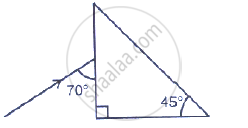
A ray of light OP passes through a right angles prism as shown in the adjacent diagram.
(a) State the angles of incidence at the faces AC and BC.
(b) Name the phenomenon which the ray suffers at the face AC. 


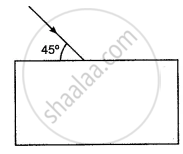
Trace the path of a ray of light incident at an angle of 45° on a rectangular glass slab. Write the measure of the angle of refraction, the angle of emergence and the lateral displacement suffered by the ray as it passes through the slab. 


A ray of light falls normally on the surface of a transparent glass slab. Draw a ray diagram to show its path and also mark angle of incidence and angle of emergence.


A ray of light is incident normally on a plane glass slab. What will be
    1. the angle of refraction and
    2. the angle of deviation for the ray?

Write the SI unit for refractive index.

Draw an í- `delta` graph for a mono chromatic raY through a glass prism of a plane and mark

(i) `delta` m, the angle of mínimum devíation

(íí) Any two values of i for which value of `delta` ís same.  


Show by a diagram the refraction of two incident rays parallel to the principle axis passing through a convex lens by treating it as a combination of a glass block and two triangular glass prisms.

Show by a diagram, the refraction of two incident rays parallel to the principle axis passing through a concave lens by treating it as a combination of a glass block and two triangular glass prisms.

Fig shows a lens as a combination of a glass block and two prisms.

(i) Name the lens formed by the combination.

(ii) What is the line XX' called?

(iii) Complete the path of the incident ray PQ after passing through the lens.

(iv) The final emergent ray either meets XX' at a point or appears to come from a point on XX'. Label it as F, What is this point called?


Fig. shows a ray of white light that passes through a prism and produces a spectrum.
(a) Name the phenomenon that is taking place.
(b) What colour would you see at X and Y?
(c) What radiation would you detect above X and below Y?


Name the phenomenon responsible in the following case:

Twinkling of stars


Does the depth of a tank of water appear to change or remain the same when viewed normally from above?


A glass slab is placed over a page on which the word VIBGYOR is printed with each letter in its corresponding colour.

  1. Will the image of all the letters be in the same place?
  2. If not, the state which letter will be raised to the maximum. Give a reason for your answer.

What is the refractive index of water


Comment on the statement ‘The refractive index of glass is 3/2.’


How is the refractive index of a medium related to its real depth and apparent depth?


What is the total reflecting prism?


The refractive index of air with respect to glass is defined: as gµa = sin i/sin r
Write down a similar expression for aµin terms of angle i and r.


In the diagram below, PQ is a ray of light incident on a rectangular glass block.

Copy the diagram and complete the path of the ray of light through the glass block. In your diagram, mark the angle of incidence by letter ‘i’ and the angle of emergence by the letter ‘e’.


A ray of monochromatic light is incident from air into a glass slab. Draw a labelled ray diagram indicating the change in its path till it emerges out of the slab. In the diagram, mark the angle of incidence (i) and the angle of refraction (r) at the first interface. How is the refractive index of glass related to the angles i and r?


Draw ray of light bending towards the normal while passing from glass to water. Label your diagrams.


Explain with the help of a diagram of how fish is able to see the objects above it.


The speed of light in air is 3 × 10ms-1. Calculate the speed of light in water. The refractive index of water is 4/3.


A ray of light strikes the surface of a rectangular glass slab such that the angle of incidence in air is

  1. 0°,
  2. 45°.

In each case, draw a diagram to show the path taken by the ray as it passes through the glass slab and emerges from it.


Share
Notifications

Englishहिंदीमराठी


      Forgot password?
Use app×