Advertisements
Advertisements
प्रश्न
Draw the diagram of refraction of light in the glass slab
Advertisements
उत्तर

APPEARS IN
संबंधित प्रश्न
Explain how spectrum is formed.
Write a short note on dispersion of light.
A student traces the path of a ray of light through a rectangular glass slab for the different values of angle of incidence. He observes all possible precautions at each step of the experiment. At the end of the experiment, on analyzing the measurements, which of the following conclusions is he likely to draw?
(A) ∠i = ∠e < ∠r
(B) ∠i < ∠e < ∠r
(C) ∠i > ∠e > ∠r
(D) ∠i = ∠e > ∠r
After tracing the path of a ray of light passing through a rectangular glass slab for four different values of the angle of incidence, a student reported his observations in tabular form as given below:
| S.No | ∠ i | ∠ r | ∠ e |
| I | 30° | 19° | 29° |
| II | 40° | 28° | 40° |
| III | 50° | 36° | 50° |
| IV | 60° | 40° | 59° |
The best observation is
(A) I
(B) II
(C) III
(D) IV
A student very cautiously traces the path of a ray through a glass slab for different values of the angle of incidence (∠i). He then measures the corresponding values of the angle of refraction (∠r) and the angle of emergence (∠e) for every value of the angle of incidence. On analysing these measurements of angles, his conclusion would be
(A) ∠i > ∠r > ∠e
(B) ∠i = ∠e > ∠r
(C) ∠i < ∠r < ∠e
(D) ∠i = ∠e < ∠r
When a ray of light from air enters a denser medium, it ______.
A student traces the path of a ray of white light through a rectangular glass slab and marks, the angles of incidence (∠i) , refraction (∠r) and emergence (∠e) as shown. Which angle or angles has he not marked correctly?

(A) ∠i only
(B) ∠i and ∠r
(C) ∠i and ∠e
(D) ∠r and ∠e
Draw an í- `delta` graph for a mono chromatic raY through a glass prism of a plane and mark
(i) `delta` m, the angle of mínimum devíation
(íí) Any two values of i for which value of `delta` ís same.
Fig shows a lens as a combination of a glass block and two prisms.
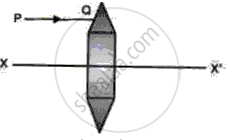
(i) Name the lens formed by the combination.
(ii) what is the XX' called?
(iii) Complete the ray diagram and show the path of the incident ray PQ after passing through the lens.
(iv) The final emergent ray will either meet XX' at a point or appear to come from a point on XX'. what is the point called?
Light of a single colour is passed through a liquid having a piece of glass suspended in it. On changing the temperature of liquid, at a particular temperature, the glass piece is not seen.
Why is the light of a single colour used ?
Name the phenomenon responsible in the following case:
Twinkling of stars
A glass slab is placed over a page on which the word VIBGYOR is printed with each letter in its corresponding colour.
- Will the image of all the letters be in the same place?
- If not, the state which letter will be raised to the maximum. Give a reason for your answer.
Name the material for which the refractive index is found to be maximum.
A ray of monochromatic light is incident from air into a glass slab. Draw a labelled ray diagram indicating the change in its path till it emerges out of the slab. In the diagram, mark the angle of incidence (i) and the angle of refraction (r) at the first interface. How is the refractive index of glass related to the angles i and r?
The figure shows two prisms A and B. A monochromatic ray of light PO is incident at the face of the prism A. Complete the diagram to show the path of the ray till it emerges out of the prism B.

Light passes through a rectangular glass slab and through a triangular glass prism. In what way does the direction of the two emergent beams differ and why?
A ray of monochromatic light is incident from the air on a glass slab:
(i) Draw a labelled ray diagram showing the change in the path of the ray till it emerges from the glass slab.
(ii) Name the two rays that are parallel to each other.
(iii) Mark the lateral displacement in your diagram.
Trace a ray of light incident at 30° on a surface if travelling from air to glass. What is the angle of refraction in this case? (R.I. for glass = 3/2).
Draw a diagram of a prism and label:
(i) the base,
(ii) the refracting surfaces,
(iii) the refracting edge,
(iv) the refracting angle in it.
