Advertisements
Advertisements
प्रश्न
Light passes through a rectangular glass slab and through a triangular glass prism. In what way does the direction of the two emergent beams differ and why?
Advertisements
उत्तर
In rectangular glass slab, the ray undergoes the only refraction and emerges out parallel. In a prism, the emerging ray is not parallel but split due to change in wavelength of different colour of light. The shape of the glass slab with two prisms up and down splits light but recombines it into one.


APPEARS IN
संबंधित प्रश्न
What is a spectrum?
Define refraction and state the laws of refraction.
If the speed of light in vacuum is 3 × 10⁸ ms−1, find the speed of light in a medium of absolute refractive index 1.5.
Light of a single colour is passed through a liquid having a piece of glass suspended in it. On changing the temperature of liquid, at a particular temperature the glass piece is not seen. When is the glass piece not seen?
Four students A, B, C and D traced the paths of incident ray and the emergent ray by fixing pins P and Q for incident ray and pins R and S for emergent ray for a ray of light passing through a glass slab.

The correct emergent ray was traced by the student:
(1) A
(2) B
(3) C
(4) D
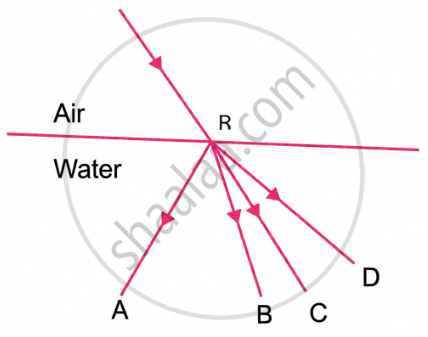
A ray of light passes from air to water. In fig., which of the ray A, B, C and D is the correct refracted ray?
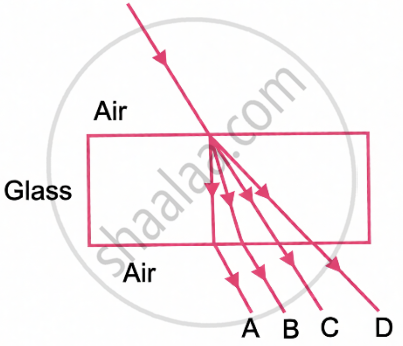
In the fig. name the ray which represents the correct path of light while passing through a glass block.
How does the deviation produced by a prism depend on the refraction index of its material.
A ray of monochromatic light is incident from air into a glass slab. Draw a labelled ray diagram indicating the change in its path till it emerges out of the slab. In the diagram, mark the angle of incidence (i) and the angle of refraction (r) at the first interface. How is the refractive index of glass related to the angles i and r?
Calculate the velocity of light in a glass block of refractive index 1.5. (Velocity of light in air = 3 × 10⁸ m/s)

