Advertisements
Advertisements
प्रश्न
A ray of light strikes the surface of a rectangular glass slab such that the angle of incidence in air is
- 0°,
- 45°.
In each case, draw a diagram to show the path taken by the ray as it passes through the glass slab and emerges from it.
Advertisements
उत्तर

APPEARS IN
संबंधित प्रश्न
What is a spectrum?
How is the reflection of light ray from a plane mirror different from the refraction of light ray as it enters a block of glass?
When a ray of light from air enters a denser medium, it ______.
With the help of diagram of the principal section of a prism, indicate its refracting surfaces, refracting edge and base.
Fill in the blanks to complete the following sentence
The refractive index of glass with respect to air is 3/2. The refractive index of air with respect to glass will be ……………….
Observe the figure and write accurate conclusion regarding refraction of light.
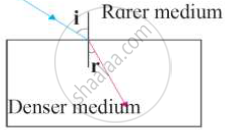
Fig shows a lens as a combination of a glass block and two prisms.
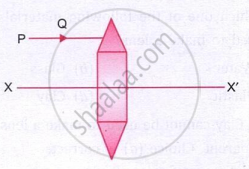
- Name the lens formed by the combination.
- What is the line XX' called?
- Complete the path of the incident ray PQ after passing through the lens.
- The final emergent ray either meets XX' at a point or appears to come from a point on XX'. Label it as F, What is this point called?
What should be the ratio of the speed of light through the liquid to the speed through the glass so that there is no refraction of light at the boundaries of the glass block when the system is illuminated by the light of one colour?
The diagram shows the path of a ray of light through a rectangular glass block placed in a liquid of uniform density.

What should be the rate of the speed of light through the liquid to the speed through the glass so that there is no refraction of light at the boundaries of the glass block when the system is illuminated by the light of one colour?
Trace a ray of light incident at 30° on a surface if travelling from glass to air. What is the angle of refraction in this case? (R.I. for glass = 3/2).
