Advertisements
Advertisements
प्रश्न
What should be the ratio of the speed of light through the liquid to the speed through the glass so that there is no refraction of light at the boundaries of the glass block when the system is illuminated by the light of one colour?
Advertisements
उत्तर
Since there is no refraction of light at the boundaries of the glass block, it is possible only when the speed of light through the liquid as well as through the block is the same. Hence the ratio between the speed of light through the liquid to the speed of light through glass must be 1 (one).
संबंधित प्रश्न
A light ray in passing from water to a medium
(a) speeds up
(b) slows down. In each case, give one example of the medium.
A ray of light is passing from a transparent medium 1 to another transparent medium 2 (i) Speed up (ii) slows down. In each case, state whether the refractive index of medium 2 is equal to, less than or greater than the refractive index of medium 1.
A ray of light OP passes through a right angles prism as shown in the adjacent diagram.
(a) State the angles of incidence at the faces AC and BC.
(b) Name the phenomenon which the ray suffers at the face AC.
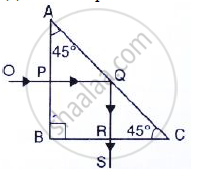
Fig shows a lens as a combination of a glass block and two prisms.
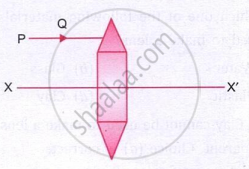
- Name the lens formed by the combination.
- What is the line XX' called?
- Complete the path of the incident ray PQ after passing through the lens.
- The final emergent ray either meets XX' at a point or appears to come from a point on XX'. Label it as F, What is this point called?
Draw a ray diagram showing the lateral displacement of a ray of light when it passes through a parallel sided glass slab.
A fish swimming in a pond seems nearer than it really is. Explain.
Name the material for which the refractive index is found to be maximum.
How is the refractive index of a medium related to its real depth and apparent depth?
