Advertisements
Advertisements
प्रश्न
A fish swimming in a pond seems nearer than it really is. Explain.
Advertisements
उत्तर
This is because a light ray coming from the fish inside the water when suffers refraction at the water-air interface, it bends away from the normal at the point of incidence. The refracted ray appears to be coming from a point at a depth less than the actual depth of the fish. That is why the fish seems to be nearer than it really is.
APPEARS IN
संबंधित प्रश्न
Select from the following the best experimental setup for tracing the path of a ray of light passing through a rectangular glass slab.
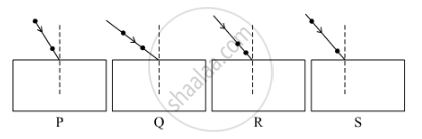
(a) P
(b) Q
(c) R
(d) S
Why do we get a spectrum of seven colors when white light is dispersed by a prism?
With the help of diagram of the principal section of a prism, indicate its refracting surfaces, refracting edge and base.
How does the speed of light change when it passes from glass to water?
Fill in the blanks to complete the following sentence
When light travels from a denser to a rarer medium, its speed ……………….
Select from the following the best experimental set-up for tracing the path of a ray of light through a glass slab: (A) I
(A) I
(B) II
(C) III
(D) IV
Which colour of light travels fastest in any medium except air?
How does the angle of deviation produced by a prism depend on the angle of incidence of light at the prism surface? Draw a graph to illustrate your answer.
A ray of monochromatic light is incident from the air on a glass slab:
(i) Draw a labelled ray diagram showing the change in the path of the ray till it emerges from the glass slab.
(ii) Name the two rays that are parallel to each other.
(iii) Mark the lateral displacement in your diagram.
