Advertisements
Advertisements
प्रश्न
A fish swimming in a pond seems nearer than it really is. Explain.
Advertisements
उत्तर
This is because a light ray coming from the fish inside the water when suffers refraction at the water-air interface, it bends away from the normal at the point of incidence. The refracted ray appears to be coming from a point at a depth less than the actual depth of the fish. That is why the fish seems to be nearer than it really is.
APPEARS IN
संबंधित प्रश्न
Explain how spectrum is formed.
Why is the ratio of the velocities of light of wavelengths 4000Å and 8000Å in vacuum 1: 1?
How is the refractive index of a medium related to the speed of light in it?
Light of a single colour is passed through a liquid having a piece of glass suspended in it. On changing the temperature of liquid, at a particular temperature the glass piece is not seen. When is the glass piece not seen?
In fig 4.18, name the ray which represents the correct path of light while emerging out through a glass block.
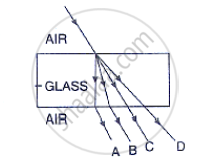
Four students showed the following traces of the path of a ray of light passing through a rectangular glass slab.

The trace most likely to be correct is that of student
(A) I
(B) II
(C) III
(D) IV
Draw a diagram of a prism and label:
(i) the base,
(ii) the refracting surfaces,
(iii) the refracting edge,
(iv) the refracting angle in it.
A ray of light PQ is incident normally on the hypotenuse of a right-angled prism ABC as shown in the diagram given below:

(i) Copy the diagram and complete the path of the ray PQ till it emerges from the prism.
(ii) What is the value of the angle of deviation of the ray?
(iii) Name an instrument where this action of the prism is used.
