Advertisements
Advertisements
प्रश्न
Name the phenomenon responsible in the following case:
Apparent bending of a stick in water
Advertisements
उत्तर
Refraction of light
संबंधित प्रश्न
Why do we get a spectrum of seven colors when white light is dispersed by a prism?
Draw the diagram given below and clearly show the path taken by the emergent ray.
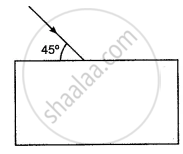
How does the angle of deviation produced by a prism change with increase in the angle of incidence. Draw a curve showing the variation in the angle of deviation with the angle of incidence at a prism surface.
The diagram alongside shows the refraction of a ray of light from air to a liquid.
- Write the values of (i) angle of incidence, (ii) angle of refraction.
- Use Snell’s law to find the refractive index of liquid with respect to air.

Which of the following is the best experimental set-up out of the four shown for tracing the path of a ray of light passing through a rectangular glass slab ?
Fill in the blank to complete the following sentence:
When light travels from a rarer to a denser medium, it bends ...........
Make the correct for each of the following :
With reference to the fig, the refractive index of the glass block is
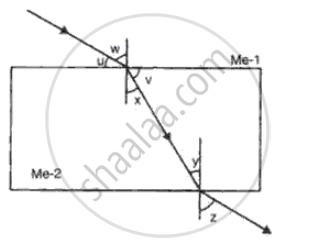
How is the refractive index of a medium related to its real depth and apparent depth?
Draw ray of light bending towards the normal while passing from air to glass. Label your diagrams.
After a robbery, if a window has been broken, there will be tiny particles of glass. Some of these will be found at the scene of the crime and some may be caught in the thief’s clothing. If the police can prove that these particles are identical, they have a strong case.
A method of doing this is to suspend the particles of glass in a special liquid. Light of a single colour is thrown through the liquid and the particles viewed through a microscope. The temperature of the liquid is then slowly altered. This alters the speed of light through the liquid (i.e., it alters the refractive index). At one particular temperature, the particles of glass disappear. It this happens at the same temperature for both sets of glass particles, they probably came from the same broken pane of glass.
Complete and copy the diagram to show how light bends when it travels from the liquid to the glass and back to the liquid, If the light slows down in the glass.
