Advertisements
Advertisements
प्रश्न
The diagram alongside shows the refraction of a ray of light from air to a liquid.
- Write the values of (i) angle of incidence, (ii) angle of refraction.
- Use Snell’s law to find the refractive index of liquid with respect to air.

Advertisements
उत्तर
(a) (i) Angle of incidence is the angle which the incident ray makes with normal.
∠i = 90° - 30° = 60°
(ii) The angle that the refracted beam creates with the normal is known as the angle of refraction.
∠r = 90° - 45° = 45°
(b) liquid's refractive index in relation to air.
μ Liquid = `sin i/sin r`
= `(sin 60°)/(sin 45°)`
= `(sqrt3/2)/(1/sqrt2)`
= `sqrt3/2 xx sqrt2`
= `(sqrt3 xx sqrt2)/(sqrt2 xx sqrt2)`
= `sqrt(3/2)`
APPEARS IN
संबंधित प्रश्न
Explain the term absolute refractive index of a medium and write an expression to relate it with the speed of light in vacuum.
Observe the following figure and answer the questions given under it:

1) How many times does refraction take place in the above figure?
2) What happens to the ray of light when it passes from air to glass?
3) What happens to the ray of light when it passes from glass to air?
4) What are the rays AB and CD in the figure called?
5) Define refraction.
Write the relation between the angle of incidence and the angle of refraction for a medium.
When light travels from a rarer to a denser medium, its speed ______.
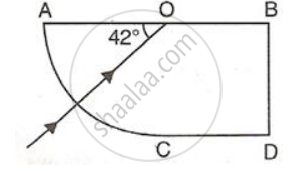
A ray of light enters a glass slab ABDC as shown in figure and strikes at the centre O of the circular part AC of the slab. The critical angle of glass is 42°. Complete the path of the ray till it emerges out from the slab. Mark the angles in the diagram wherever necessary.
Draw a diagram to show the refraction of a monochromatic light ray through an equilateral prism. On the diagram, label the incident, refracted, and emergent rays. It also indicates the angle of deviation by the letter δ.
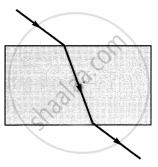
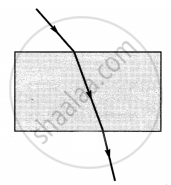
The path of a ray of light coming from air passing through a rectangular glass slab traced by four students are shown as A, B, C and D in the figure. Which one of them is correct?
 |
 |
 |
 |
| A | B | C | D |
