Advertisements
Advertisements
प्रश्न
A postage stamp kept below a rectangular glass block of refractive index 1.5 when viewed from vertically above it, appears to be raised by 7.0 mm. Calculate the thickness of the glass slab.
Advertisements
उत्तर
Refractive index of glass = 1.5
Let the thickness of slab = x mm
stamp raised by = 7 mm
∴ observed depth. = (x - 7) mm
R.I = `"Real depth"/"observed depth"`
= `3/2 = x/((x - 7))`
∴ 3x - 21 = 2x
Or x = 21 mm = 2.1 cm
APPEARS IN
संबंधित प्रश्न
State the dependence of angle of deviation on the wavelength of light
How is the reflection of light ray from a plane mirror different from the refraction of light ray as it enters a block of glass?
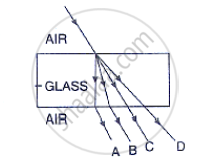
In fig 4.18, name the ray which represents the correct path of light while emerging out through a glass block.
An object is viewed through a glass prism with its vertex pointing upwards. It appears to be displaced upward. Explain the reason.
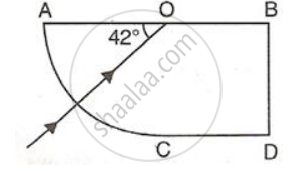
A ray of light enters a glass slab ABDC as shown in figure and strikes at the centre O of the circular part AC of the slab. The critical angle of glass is 42°. Complete the path of the ray till it emerges out from the slab. Mark the angles in the diagram wherever necessary.
Make the correct for each of the following :
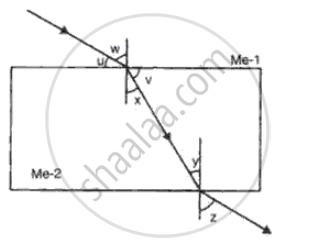
With reference to the fig, the refractive index of the glass block is
How does the deviation produced by a prism depend on the refraction index of its material.
Choose the correct alternative and rewrite the following:
A glass slab is placed in the path of convergent light. The point of convergence of light
How does the angle of deviation produced by a prism depend on the colour of light used? Which colour of white light is deviated (i) most, (ii) least, by a prism?
In the diagram alongside a ray of light, PQ is incident normally on one face AB of an equilateral glass prism. What is the angle of incidence at the faces AB and AC?

