Advertisements
Advertisements
Question
A postage stamp kept below a rectangular glass block of refractive index 1.5 when viewed from vertically above it, appears to be raised by 7.0 mm. Calculate the thickness of the glass slab.
Advertisements
Solution
Refractive index of glass = 1.5
Let the thickness of slab = x mm
stamp raised by = 7 mm
∴ observed depth. = (x - 7) mm
R.I = `"Real depth"/"observed depth"`
= `3/2 = x/((x - 7))`
∴ 3x - 21 = 2x
Or x = 21 mm = 2.1 cm
APPEARS IN
RELATED QUESTIONS
Why do we get a spectrum of seven colors when white light is dispersed by a prism?
Draw the diagram of refraction of light in the glass slab
How must light travel out of a substance if it is not going to be refracted?
A ray of light is passing from a transparent medium 1 to another transparent medium 2 (i) Speed up (ii) slows down. In each case, state whether the refractive index of medium 2 is equal to, less than or greater than the refractive index of medium 1.
In fig 4.18, name the ray which represents the correct path of light while emerging out through a glass block.
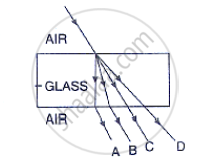
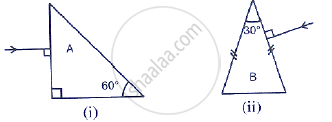
Fig 4.31 below shows a light ray of single colour incident normally on two prisms A and B. In each case draw the path of the ray of light as it enters and emerges out of the prism. Mark the angle wherever necessary.
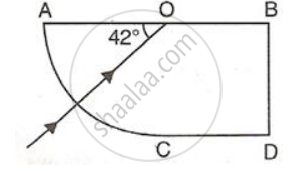
A ray of light enters a glass slab ABDC as shown in figure and strikes at the centre O of the circular part AC of the slab. The critical angle of glass is 42°. Complete the path of the ray till it emerges out from the slab. Mark the angles in the diagram wherever necessary.
Observe the figure and name the ray AB, ray CD, ray GH.

