Advertisements
Advertisements
Question
Observe the figure and name the ray AB, ray CD, ray GH.

Advertisements
Solution
- Ray AB - Incident ray
- Ray CD - Refracted ray
- Ray GH - Emergent ray
APPEARS IN
RELATED QUESTIONS
Define refraction and state the laws of refraction.
Light passes through a rectangular glass slab and through a triangular glass prism. In what way does the direction of the two emergent beams differ and why?
With the help of diagram of the principal section of a prism, indicate its refracting surfaces, refracting edge and base.
An object is viewed through a glass prism with its vertex pointing upwards. It appears to be displaced upward. Explain the reason.
Select from the following the best experimental set-up for tracing the path of a ray of light through a glass slab: (A) I
(A) I
(B) II
(C) III
(D) IV
Select from the following the best set-up for tracing the path of a ray of light through a rectangular glass slab:

(A) I
(B) II
(C) III
(D) IV
While performing the experiment on tracing the path of a ray of light through a rectangular glass slab, in which of the following experimental set-ups is a student likely to get best results? P1 and P2 are the positions of pins fixed by him.
(A) I
(B) II
(C) III
(D) IV
Fill in the blank to complete the following sentence:
When light travels from a rarer to a denser medium, it bends ...........
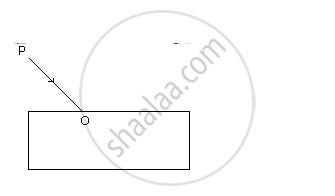
In the fig., PO is a ray of light incident on a rectangular glass block.
(a) Complete the path of the ray through the block.
(b) In the diagram, mark the angle of incidence (i) and the angle of refraction (r) at the first interface. How is the refractive index of glass related to the angles I and r?
(c) Mark angle of emergence by the letter e. How are the angles i and e related?
(d) Which two rays are parallel to each other? Name them.
(e) Indicate in the diagram the lateral displacement between the emergent ray and the incident ray.
Name the phenomenon responsible in the following case:
Apparent bending of a stick in water
Glass is transparent in nature. Why does glass powder look opaque? When water is poured over it, it again becomes transparent. Why?
Does the depth of a tank of water appear to change or remain the same when viewed normally from above?
What should be the ratio of the speed of light through the liquid to the speed through the glass so that there is no refraction of light at the boundaries of the glass block when the system is illuminated by the light of one colour?
How is the refractive index of a medium related to its real depth and apparent depth?
Complete the ray diagram showing its emergence into the air after passing through the prism.

The diagram shows the path of a ray of light through a rectangular glass block placed in a liquid of uniform density.

Show with the help of a ray diagram the path of the ray when incident ray normally falls on the first surface of the glass block and passes through the block and the liquid.
The refractive index of glass with respect to air is 3/2. What is the refractive index of air with respect to glass?
