Advertisements
Advertisements
प्रश्न
Observe the figure and name the ray AB, ray CD, ray GH.

Advertisements
उत्तर
- Ray AB - Incident ray
- Ray CD - Refracted ray
- Ray GH - Emergent ray
APPEARS IN
संबंधित प्रश्न
Define refraction and state the laws of refraction.
Draw a ray diagram to show the refraction of light through a glass slab and mark angle of refraction and the lateral shift suffered by the ray of light while passing through the slab.
State the dependence of angle of deviation on the wavelength of light
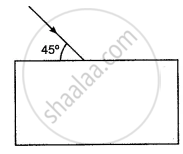
Draw the diagram given below and clearly show the path taken by the emergent ray.
When a lighted candle is held in front of a thick plane glass mirror, several images can be seen, but the second image is the brightest, give reason.
When a ray of light from air enters a denser medium, it ______.
How does the angle of deviation produced by a prism change with increase in the angle of incidence. Draw a curve showing the variation in the angle of deviation with the angle of incidence at a prism surface.
A ray of light is passing from a transparent medium 1 to another transparent medium 2 (i) Speed up (ii) slows down. In each case, state whether the refractive index of medium 2 is equal to, less than or greater than the refractive index of medium 1.
A ray of light falls normally on the surface of a transparent glass slab. Draw a ray diagram to show its path and also mark angle of incidence and angle of emergence.
In an experiment of finding the refractive index of glass, if blue light is replaced by the red light, how will the refractive index of glass change? Give reason in support of your answer.
Which colour of light travels fastest in any medium except air?
Which colour of light travels fastest in any medium except air?
What do you understand by the deviation produced by a prism?
A ray of monochromatic light is incident from air into a glass slab. Draw a labelled ray diagram indicating the change in its path till it emerges out of the slab. In the diagram, mark the angle of incidence (i) and the angle of refraction (r) at the first interface. How is the refractive index of glass related to the angles i and r?
Complete the ray diagram showing its emergence into the air after passing through the prism.

The diagram shows the path of a ray of light through a rectangular glass block placed in a liquid of uniform density.

What should be the rate of the speed of light through the liquid to the speed through the glass so that there is no refraction of light at the boundaries of the glass block when the system is illuminated by the light of one colour?
Consider these indices of refraction: glass: 1.52; air: 1.0003; water: 1.333. Based on the refractive indices of three materials, arrange the speed of light through them in decreasing order.
