मराठी

State the Dependence of Angle of Deviation On the Wavelength of Light

Advertisements
Advertisements

प्रश्न

State the dependence of angle of deviation On the wavelength of light

Advertisements

उत्तर

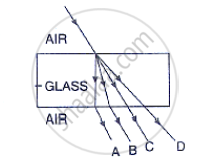
The angle of deviation decreases with an increase in the wavelength of light. Thus, a prism deviates violet light the most and red light the least.

shaalaa.com
  या प्रश्नात किंवा उत्तरात काही त्रुटी आहे का?
2015-2016 (March) Science Paper 1

संबंधित प्रश्‍न

In your laboratory you trace the path of light rays through a glass slab for different values of angle of incidence (∠i) and in each case measure the values of the corresponding angle of refraction (∠r) and angle of emergence (∠e). On the basis of your observations your correct conclusion is:

(a) ∠i is more than ∠r, but nearly equal to ∠e

(b) ∠i is less then ∠r, but nearly equal to ∠e

(c) ∠i is more than ∠e, but nearly equal to ∠r

(d) ∠i is less than ∠e, but nearly equal to ∠r


How does the angle of minimum deviation produces by a prism change with increase in :

the wavelength of incident light 


The critical angle for glass-air is 45° for the light of yellow colour. State whether it will be less than, equal to, or more than 45° for (i) ref light, (ii) blue light? 


For which colour of white light, is the refractive index of a transparent medium the least?

Name the factors on which the deviation produced by a prism depends.

Briefly, describe an experiment to show that a prism itself produces no colour.

After a robbery, if a window has been broken, there will be tiny particles of glass. Some of these will be found at the scene of the crime and some may be caught in the thief’s clothing. If the police can prove that these particles are identical, they have a strong case.
A method of doing this is to suspend the particles of glass in a special liquid. Light of a single colour is thrown through the liquid and the particles viewed through a microscope. The temperature of the liquid is then slowly altered. This alters the speed of light through the liquid (i.e., it alters the refractive index). At one particular temperature, the particles of glass disappear. It this happens at the same temperature for both sets of glass particles, they probably came from the same broken pane of glass.
Complete and copy the diagram to show how light bends when it travels from the liquid to the glass and back to the liquid, If the light slows down in the glass.


Complete the ray diagram showing its emergence into the air after passing through the prism.


Write the approximate values of speed of light in (i) air and (ii) glass. Use these values to calculate the refractive index of glass with respect to air.


Consider these indices of refraction: glass: 1.52; air: 1.0003; water: 1.333. Based on the refractive indices of three materials, arrange the speed of light through them in decreasing order.


Share
Notifications

Englishहिंदीमराठी


      Forgot password?
Use app×