Advertisements
Advertisements
प्रश्न
Advertisements
उत्तर
The value of angle of deviation produced by a prism depends upon:
(i) The angle of incidence
(ii) The material of prism
(iii) The angle of prism
(iv) The colour of wavelength of light used.
APPEARS IN
संबंधित प्रश्न
Explain how spectrum is formed.
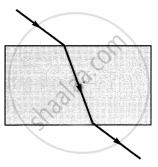
Draw a ray diagram to show the refraction of light through a glass slab and mark angle of refraction and the lateral shift suffered by the ray of light while passing through the slab.
Which colour of light travels fastest in any medium except air?
Observe the following figure and answer the questions given under it:

1) How many times does refraction take place in the above figure?
2) What happens to the ray of light when it passes from air to glass?
3) What happens to the ray of light when it passes from glass to air?
4) What are the rays AB and CD in the figure called?
5) Define refraction.
A ray of light strikes the surface of a rectangular glass block such that the angle of incidence in
air is 0°.
In each case, draw diagram to show the path taken by the ray as it passes through the glass block and emerges from it.
In an experiment of finding the refractive index of glass, if blue light is replaced by the red light, how will the refractive index of glass change? Give reason in support of your answer.
How does the angle of deviation produced by a prism depend on the colour of light used? Which colour of white light is deviated (i) most, (ii) least, by a prism?
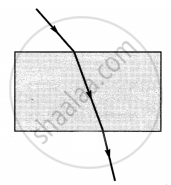
The path of a ray of light coming from air passing through a rectangular glass slab traced by four students are shown as A, B, C and D in the figure. Which one of them is correct?
 |
 |
 |
 |
| A | B | C | D |
