Advertisements
Advertisements
Question
Advertisements
Solution
The value of angle of deviation produced by a prism depends upon:
(i) The angle of incidence
(ii) The material of prism
(iii) The angle of prism
(iv) The colour of wavelength of light used.
APPEARS IN
RELATED QUESTIONS
A student very cautiously traces the path of a ray through a glass slab for different values of the angle of incidence (∠i). He then measures the corresponding values of the angle of refraction (∠r) and the angle of emergence (∠e) for every value of the angle of incidence. On analysing these measurements of angles, his conclusion would be
(A) ∠i > ∠r > ∠e
(B) ∠i = ∠e > ∠r
(C) ∠i < ∠r < ∠e
(D) ∠i = ∠e < ∠r
How is the reflection of light ray from a plane mirror different from the refraction of light ray as it enters a block of glass?
The highest refractive index is of ______.
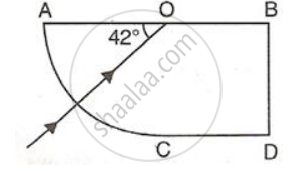
A ray of light enters a glass slab ABDC as shown in figure and strikes at the centre O of the circular part AC of the slab. The critical angle of glass is 42°. Complete the path of the ray till it emerges out from the slab. Mark the angles in the diagram wherever necessary.
Four students A, B, C and D traced the paths of incident ray and the emergent ray by fixing pins P and Q for incident ray and pins R and S for emergent ray for a ray of light passing through a glass slab.

The correct emergent ray was traced by the student:
(1) A
(2) B
(3) C
(4) D
-
- the angle of refraction and
- the angle of deviation for the ray?
In an experiment of finding the refractive index of glass, if blue light is replaced by the red light, how will the refractive index of glass change? Give reason in support of your answer.
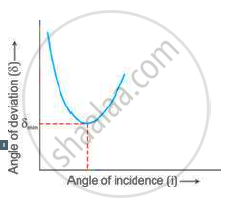
Using the curve, how do you infer that for given prism, the angle of minimum deviation δmin is unique for the given light?
Does the depth of a tank of water appear to change or remain the same when viewed normally from above?
In the diagram below, PQ is a ray of light incident on a rectangular glass block.

Copy the diagram and complete the path of the ray of light through the glass block. In your diagram, mark the angle of incidence by letter ‘i’ and the angle of emergence by the letter ‘e’.
