Advertisements
Advertisements
प्रश्न
Advertisements
उत्तर
Refraction is the bending of light at the surface of separation, which takes when it passes from one optical medium to another optical medium with different optical densities.
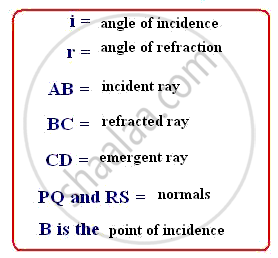
Ray diagram showing refraction of light through a glass slab:

APPEARS IN
संबंधित प्रश्न
Observe the following figure and answer the questions given under it:

1) How many times does refraction take place in the above figure?
2) What happens to the ray of light when it passes from air to glass?
3) What happens to the ray of light when it passes from glass to air?
4) What are the rays AB and CD in the figure called?
5) Define refraction.
Draw diagrams to show the refraction of light from
- air to glass, and
- glass to air. In each diagram, label the incident ray, refracted ray, the angle of incidence
- and the angle of refraction (r).
How does the angle of minimum deviation produces by a prism change with increase in :
the refracting angle of prism?
The diagram alongside shows the refraction of a ray of light from air to a liquid.
- Write the values of (i) angle of incidence, (ii) angle of refraction.
- Use Snell’s law to find the refractive index of liquid with respect to air.

Fill in the blanks to complete the following sentence
When light travels from a denser to a rarer medium, its speed ……………….
Explain briefly what causes the twinkling of stars at night.
The diagram shows the path of a ray of light through a rectangular glass block placed in a liquid of uniform density.

What should be the rate of the speed of light through the liquid to the speed through the glass so that there is no refraction of light at the boundaries of the glass block when the system is illuminated by the light of one colour?
Explain with the help of a diagram of how fish is able to see the objects above it.
