Advertisements
Advertisements
प्रश्न
Draw diagrams to show the refraction of light from
- air to glass, and
- glass to air. In each diagram, label the incident ray, refracted ray, the angle of incidence
- and the angle of refraction (r).
Advertisements
उत्तर

Refraction of Light:
-
The incident ray from air to glass bends towards the normal PO, or refracted ray, and the OQ, or incident ray.
- It bends away from the normal PO, incident ray, and OQ, refracted ray, as it travels from glass to air.

APPEARS IN
संबंधित प्रश्न
Select from the following the best experimental setup for tracing the path of a ray of light passing through a rectangular glass slab.
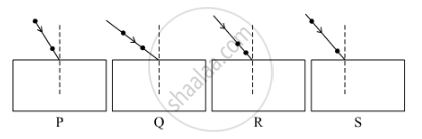
(a) P
(b) Q
(c) R
(d) S
For which colour of white light, is the refractive index of a transparent medium the most?
How is the angle of emergence related to the angle of incidence when prism is in the position of minimum deviation? Illustrate your answer with help of a labelled diagram using an equilateral prism?
A ray of light OP passes through a right angles prism as shown in the adjacent diagram.
(a) State the angles of incidence at the faces AC and BC.
(b) Name the phenomenon which the ray suffers at the face AC.
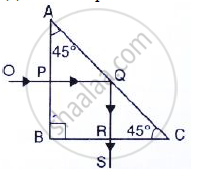
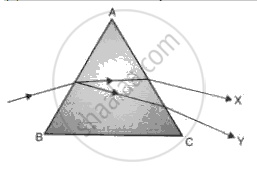
Fig. shows a ray of white light that passes through a prism and produces a spectrum.
(a) Name the phenomenon that is taking place.
(b) What colour would you see at X and Y?
(c) What radiation would you detect above X and below Y?
Choose the correct alternative and rewrite the following:
A glass slab is placed in the path of convergent light. The point of convergence of light
Name the phenomenon responsible in the following case:
Twinkling of stars
Why is the colour red used as a sign of danger?
What should be the ratio of the speed of light through the liquid to the speed through the glass so that there is no refraction of light at the boundaries of the glass block when the system is illuminated by the light of one colour?
Define the term refractive index of a medium in terms of velocity of light.
