Advertisements
Advertisements
प्रश्न
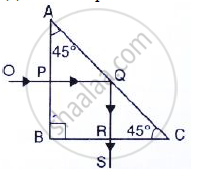
A ray of light OP passes through a right angles prism as shown in the adjacent diagram.
(a) State the angles of incidence at the faces AC and BC.
(b) Name the phenomenon which the ray suffers at the face AC.
Advertisements
उत्तर
(a) The angle of incidence at the face AC is 45° and angle of incidence at the face BC is 0°.
(b) The ray suffers total internal reflection at the face AC.
संबंधित प्रश्न
A student traces the path of a ray of light passing through a rectangular glass slab and marks the angle of incidence i, angle of refraction r and angle of emergence e, as shown.
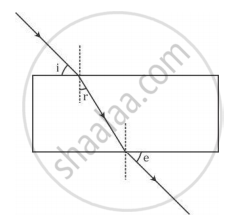
The correctly marked angle(s) is/are
(A) ∠ i only
(B) ∠ e only
(C) ∠ r only
(D) ∠ i and ∠ e
Draw a ray diagram to show the refraction of a monochromatic ray through a prism when it suffers minimum deviation.
With the help of diagram of the principal section of a prism, indicate its refracting surfaces, refracting edge and base.
Fill in the blank to complete the following sentence:
When light travels from a rarer to a denser medium, it bends ...........
Rewrite the following statement by selecting the correct option:
If a ray of light strikes a glass slab at an angle of 600 with the surface of the slab, the angle of incidence must be __________________.
Name the material for which the refractive index is found to be maximum.
Draw a diagram of a prism and label:
(i) the base,
(ii) the refracting surfaces,
(iii) the refracting edge,
(iv) the refracting angle in it.
The refractive index of glass with respect to air is 3/2. What is the refractive index of air with respect to glass?
A coin placed at the bottom of a beaker appears to be raised by 4.0 cm. If the refractive index of water is 4/3, find the depth of the water in the beaker.
