Advertisements
Advertisements
प्रश्न
Rewrite the following statement by selecting the correct option:
If a ray of light strikes a glass slab at an angle of 600 with the surface of the slab, the angle of incidence must be __________________.
पर्याय
60°
30°
40°
120°
Advertisements
उत्तर
If a ray of light strikes a glass slab at an angle of 600 with the surface of the slab, the angle of incidence must be 30°.
APPEARS IN
संबंधित प्रश्न
If the speed of light in vacuum is 3 × 10⁸ ms−1, find the speed of light in a medium of absolute refractive index 1.5.
Explain the term absolute refractive index of a medium and write an expression to relate it with the speed of light in vacuum.
Observe the following figure and answer the questions given under it:

1) How many times does refraction take place in the above figure?
2) What happens to the ray of light when it passes from air to glass?
3) What happens to the ray of light when it passes from glass to air?
4) What are the rays AB and CD in the figure called?
5) Define refraction.
Write the relation between the angle of incidence and the angle of refraction for a medium.
How is the angle of emergence related to the angle of incidence when prism is in the position of minimum deviation? Illustrate your answer with help of a labelled diagram using an equilateral prism?
Complete Fig. 4.32 to show the path of the ray of single colour as it enters the prism and emerges out of it. Mark the angles wherever necessary.
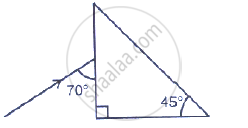
(i) What is the relation between the refractive index of water with respect to air `("_aμ_\text(w))` and the refractive index of air with respect to water `("_\text(w)μ_ a)` .
(ii) If the refractive index of water with respect to air `("_aμ_\text(w))` is`5/3`. Calculate the refractive index of air with respect to water `("_\text(w)μ_ a)` .
Fig shows a lens as a combination of a glass block and two prisms.
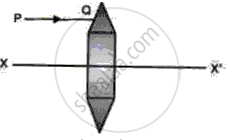
(i) Name the lens formed by the combination.
(ii) what is the XX' called?
(iii) Complete the ray diagram and show the path of the incident ray PQ after passing through the lens.
(iv) The final emergent ray will either meet XX' at a point or appear to come from a point on XX'. what is the point called?
A ray of light strikes the surface at a rectangular glass slab such that the angle of incidence is 45o.
In each case, draw diagram to show the path taken by the ray as it passes through the glass slab and emerges from it.
Using the curve, how do you infer that for given prism, the angle of minimum deviation δmin is unique for the given light?
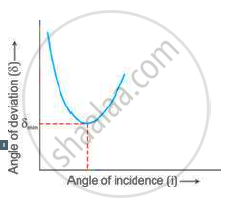
How does the deviation produced by a prism depend on the refraction index of its material.
A total reflecting equilateral prism can be used to deviate a ray of light through:
Why do the faces of persons sitting around campfire appear to shimmer?
Glass is transparent in nature. Why does glass powder look opaque? When water is poured over it, it again becomes transparent. Why?
The refractive index of air with respect to glass is defined: as gµa = sin i/sin r
Write down a similar expression for aµg in terms of angle i and r.
Draw ray of light bending towards the normal while passing from air to glass. Label your diagrams.
After a robbery, if a window has been broken, there will be tiny particles of glass. Some of these will be found at the scene of the crime and some may be caught in the thief’s clothing. If the police can prove that these particles are identical, they have a strong case.
A method of doing this is to suspend the particles of glass in a special liquid. Light of a single colour is thrown through the liquid and the particles viewed through a microscope. The temperature of the liquid is then slowly altered. This alters the speed of light through the liquid (i.e., it alters the refractive index). At one particular temperature, the particles of glass disappear. It this happens at the same temperature for both sets of glass particles, they probably came from the same broken pane of glass.
Complete and copy the diagram to show how light bends when it travels from the liquid to the glass and back to the liquid, If the light slows down in the glass.
The figure shows two prisms A and B. A monochromatic ray of light PO is incident at the face of the prism A. Complete the diagram to show the path of the ray till it emerges out of the prism B.

Calculate the velocity of light in a glass block of refractive index 1.5. (Velocity of light in air = 3 × 10⁸ m/s)

A ray of light PQ is incident normally on the hypotenuse of a right-angled prism ABC as shown in the diagram given below:

(i) Copy the diagram and complete the path of the ray PQ till it emerges from the prism.
(ii) What is the value of the angle of deviation of the ray?
(iii) Name an instrument where this action of the prism is used.
