Advertisements
Advertisements
प्रश्न
Draw ray of light bending towards the normal while passing from air to glass. Label your diagrams.
Advertisements
उत्तर
The ray of light bends towards the normal while passing from air to glass.

संबंधित प्रश्न
When rays of light are incident on a glass slab then the incident ray and emergent ray are _________ each other.
- perpendicular
- parallel
- opposite
- concurrent
Write a short note on dispersion of light.
After tracing the path of a ray of light passing through a rectangular glass slab for four different values of the angle of incidence, a student reported his observations in tabular form as given below:
| S.No | ∠ i | ∠ r | ∠ e |
| I | 30° | 19° | 29° |
| II | 40° | 28° | 40° |
| III | 50° | 36° | 50° |
| IV | 60° | 40° | 59° |
The best observation is
(A) I
(B) II
(C) III
(D) IV
Select from the following the best experimental set-up for tracing the path of a ray of light through a glass slab: (A) I
(A) I
(B) II
(C) III
(D) IV
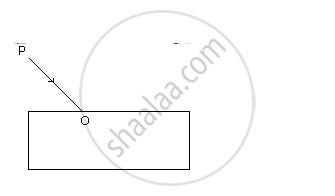
In the fig., PO is a ray of light incident on a rectangular glass block.
(a) Complete the path of the ray through the block.
(b) In the diagram, mark the angle of incidence (i) and the angle of refraction (r) at the first interface. How is the refractive index of glass related to the angles I and r?
(c) Mark angle of emergence by the letter e. How are the angles i and e related?
(d) Which two rays are parallel to each other? Name them.
(e) Indicate in the diagram the lateral displacement between the emergent ray and the incident ray.
What do you understand by the deviation produced by a prism?
The refractive index of glass with respect to air is 1.5. What is the value of the refractive index of air with respect to glass?
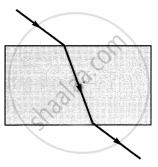
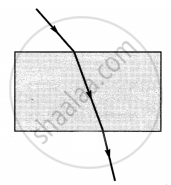
The path of a ray of light coming from air passing through a rectangular glass slab traced by four students are shown as A, B, C and D in the figure. Which one of them is correct?
 |
 |
 |
 |
| A | B | C | D |
A ray of light is incident at an angle of 45° on one face of a rectangular glass slab of thickness 10 cm and refractive index 3/2. Calculate the lateral shift produced ______.
