Advertisements
Advertisements
प्रश्न
Rewrite the following statement by selecting the correct option:
If a ray of light strikes a glass slab at an angle of 600 with the surface of the slab, the angle of incidence must be __________________.
विकल्प
60°
30°
40°
120°
Advertisements
उत्तर
If a ray of light strikes a glass slab at an angle of 600 with the surface of the slab, the angle of incidence must be 30°.
APPEARS IN
संबंधित प्रश्न
Name one factor that affects the lateral displacement of light as it passes through a rectangular glass slab.
Which colour of light travels fastest in any medium except air?
How is the reflection of light ray from a plane mirror different from the refraction of light ray as it enters a block of glass?
How is the refractive index of a medium related to the speed of light in it?
A monochromatic ray of light passes from air to glass. The wavelength of light in air is λ, the speed of light in air is c and in glass is V. If the absolute refractive index of glass is 1.5, write down
- the relationship between c and V,
- the wavelength of light in glass.
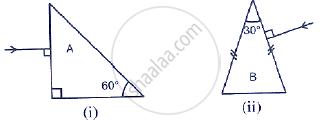
Fig 4.31 below shows a light ray of single colour incident normally on two prisms A and B. In each case draw the path of the ray of light as it enters and emerges out of the prism. Mark the angle wherever necessary.
A coin is places at the bottom of a beaker containing water (refractive index = 4/3) to a depth of 12 cm. By what height the coin appears to be raised when seen from vertically above?
After tracing the path of rays of light through a glass slab for three different angles of incidence, a student measured the corresponding values angle of refraction r and angle of emergence e and recorded them in the table given below:
|
S. No. |
∠i |
∠i |
∠e |
|
I |
30° |
20° |
31° |
|
II |
40° |
25° |
40° |
|
III |
50° |
31° |
49° |
The correct observations are:
(A) I and II
(B) II and III
(C) I and III
(D) I, II and III
Select from the following the best set-up for tracing the path of a ray of light through a rectangular glass slab:

(A) I
(B) II
(C) III
(D) IV
What is the correct reason for blinking / flickering of stars? Explain it.
a) The blasts in the stars.
b) Absorption of star light by the atmosphere.
c) Motion of the stars.
d) Changing refractive index of gases in the atmosphere.
Fig shows a lens as a combination of a glass block and two prisms.
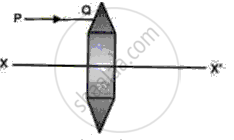
(i) Name the lens formed by the combination.
(ii) what is the XX' called?
(iii) Complete the ray diagram and show the path of the incident ray PQ after passing through the lens.
(iv) The final emergent ray will either meet XX' at a point or appear to come from a point on XX'. what is the point called?
Which colour of light travels fastest in any medium except air?
Using the curve, how do you infer that for given prism, the angle of minimum deviation δmin is unique for the given light?
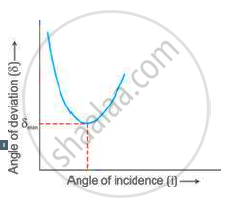
How does the deviation produced by a prism depend on the wavelength of incident light?
What should be the ratio of the speed of light through the liquid to the speed through the glass so that there is no refraction of light at the boundaries of the glass block when the system is illuminated by the light of one colour?
You are provided with a printed piece of paper. Using this paper how will you differentiate between a convex lens and a concave lens?
In the diagram below, PQ is a ray of light incident on a rectangular glass block.

How are the angles ‘i’ and ‘e’ related to each other?
Two parallel rays of Red and Violet travelling through the air, meet the air-glass boundary as shown in the above figure. Will their paths inside the glass be parallel? Give a reason for your answer.

Observe the figure and name the ray AB, ray CD, ray GH.

