Advertisements
Advertisements
प्रश्न
A monochromatic ray of light passes from air to glass. The wavelength of light in air is λ, the speed of light in air is c and in glass is V. If the absolute refractive index of glass is 1.5, write down
- the relationship between c and V,
- the wavelength of light in glass.
Advertisements
उत्तर
aμg = 1.5, aμg = `"speed of light in air"/"speed of light in glass" = c/V`
- μ or c = aμg × V = 1.5 V
- aμg = `"wave length of light in air"/"wave length of light in glass"`
∴ wave length of light in glass = `λ/ 1.5`
APPEARS IN
संबंधित प्रश्न
Explain how spectrum is formed.
Study the following four experimental set-ups I, II, III and IV for the experiment, "To trace the path of a ray of light through a rectangular glass slab."

Which of the marked set-ups is likely to give best results (P1 and P2 are the positions of pins fixed on the incident ray)?
(A) I
(B) II
(C) III
(D) IV
Explain the term absolute refractive index of a medium and write an expression to relate it with the speed of light in vacuum.
The highest refractive index is of ______.
-
- the angle of refraction and
- the angle of deviation for the ray?
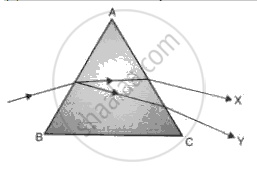
Fig. shows a ray of white light that passes through a prism and produces a spectrum.
(a) Name the phenomenon that is taking place.
(b) What colour would you see at X and Y?
(c) What radiation would you detect above X and below Y?
Express the refractive index μ of a medium in terms of the velocity of light.
How does the angle of deviation produced by a prism depend on the colour of light used? Which colour of white light is deviated (i) most, (ii) least, by a prism?
Draw a diagram to show the refraction of a monochromatic light ray through an equilateral prism. On the diagram, label the incident, refracted, and emergent rays. It also indicates the angle of deviation by the letter δ.
