Advertisements
Advertisements
प्रश्न
Choose the correct alternative and rewrite the following sentence.
A ray of light strikes the glass slab at an angle of 50°. What is the angle of incidence?
विकल्प
50°
90°
60°
40°
Advertisements
उत्तर
40°
The ray of light strikes at an angle of 50 with the horizontal. The angle of incidence is with respect to the normal, so the angle of incidence is 90° − 50° = 40°.
APPEARS IN
संबंधित प्रश्न
Four students P, Q, R and S traced the path of a ray of light passing through a glass slab for an angle of incidence 40° and measured the angle of refraction. The values as measured them were 18°; 22°; 25° and 30° respectively. The student who has performed the experiment methodically is
(A) P
(B) Q
(C) R
(D) S
A student very cautiously traces the path of a ray through a glass slab for different values of the angle of incidence (∠i). He then measures the corresponding values of the angle of refraction (∠r) and the angle of emergence (∠e) for every value of the angle of incidence. On analysing these measurements of angles, his conclusion would be
(A) ∠i > ∠r > ∠e
(B) ∠i = ∠e > ∠r
(C) ∠i < ∠r < ∠e
(D) ∠i = ∠e < ∠r
Draw a ray diagram to show the refraction of a monochromatic ray through a prism when it suffers minimum deviation.
Name one factor that affects the lateral displacement of light as it passes through a rectangular glass slab.
How is the reflection of light ray from a plane mirror different from the refraction of light ray as it enters a block of glass?
For which colour of white light, is the refractive index of a transparent medium the most?
How does the angle of minimum deviation produces by a prism change with increase in :
the refracting angle of prism?
An object is viewed through a glass prism with its vertex pointing upwards. It appears to be displaced upward. Explain the reason.
Complete Fig. 4.32 to show the path of the ray of single colour as it enters the prism and emerges out of it. Mark the angles wherever necessary.
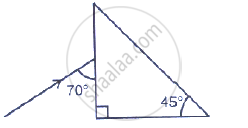
Fill in the blank to complete the following sentence:
When light travels from a rarer to a denser medium, it bends ...........
Make the correct for each of the following :
With reference to the fig, the refractive index of the glass block is
What is the refractive index of water
The refractive index of air with respect to glass is defined: as gµa = sin i/sin r
Write down a similar expression for aµg in terms of angle i and r.
A ray of light moves from a rare medium to a dense medium as shown in the diagram below. Write down the number of the ray which represents the partially reflected ray.

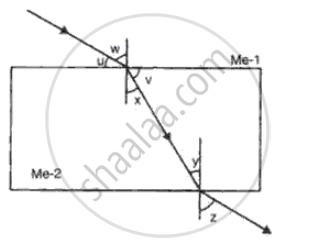
In the diagram below, PQ is a ray of light incident on a rectangular glass block.

How are the angles ‘i’ and ‘e’ related to each other?
A ray of monochromatic light is incident from the air on a glass slab:
(i) Draw a labelled ray diagram showing the change in the path of the ray till it emerges from the glass slab.
(ii) Name the two rays that are parallel to each other.
(iii) Mark the lateral displacement in your diagram.
The velocity of light in diamond is 121000 kms-1. What is its refractive index?
Consider these indices of refraction: glass: 1.52; air: 1.0003; water: 1.333. Based on the refractive indices of three materials, arrange the speed of light through them in decreasing order.
