Advertisements
Advertisements
प्रश्न
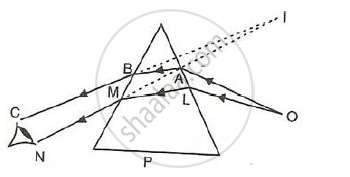
An object is viewed through a glass prism with its vertex pointing upwards. It appears to be displaced upward. Explain the reason.
Advertisements
उत्तर
Let two rays OA and OL from a source O are incident on the prism. They are refracted along AB and LM from first face of the prism. These two rays again refract from the second face of the prism emerge out along BC and MN respectively such that they appear to come from I.
संबंधित प्रश्न
How does the angle of minimum deviation produces by a prism change with increase in :
the wavelength of incident light
What do you understand by the statement the refractive index of glass is 1.5 for white light?
“A ray of light incident on a rectangular glass slab immersed in any medium emerges parallel to itself.” Draw labelled ray diagram to justify the statement.
Four students showed the following traces of the path of a ray of light passing through a rectangular glass slab.

The trace most likely to be correct is that of student
(A) I
(B) II
(C) III
(D) IV
Draw an í- `delta` graph for a mono chromatic raY through a glass prism of a plane and mark
(i) `delta` m, the angle of mínimum devíation
(íí) Any two values of i for which value of `delta` ís same.
Why upper surface of water contained in a beaker and above eye level appears silvery?
Name two instruments of the total refracting prism in which is used.
Trace a ray of light incident at 30° on a surface if travelling from glass to air. What is the angle of refraction in this case? (R.I. for glass = 3/2).
A coin placed at the bottom of a beaker appears to be raised by 4.0 cm. If the refractive index of water is 4/3, find the depth of the water in the beaker.
Draw the ray diagram of a glass slab having medium A and B for the velocity of light ray VA and VB respectively and define Snell's law.
- If VB = 1.5 VA, then which medium is denser?
- What is the refractive index of A with respect to B?
- What is the refractive index of B with respect to A?
