Advertisements
Advertisements
प्रश्न
Draw the ray diagram of a glass slab having medium A and B for the velocity of light ray VA and VB respectively and define Snell's law.
- If VB = 1.5 VA, then which medium is denser?
- What is the refractive index of A with respect to B?
- What is the refractive index of B with respect to A?
Advertisements
उत्तर

Where i = angle of incidence,
r = angle of refraction,
e = angle of emergence
At point N, using snell's law
AηB = `sin "i"/sin "r"` = constant
According to snell's law, the sin i of the angle of incidence to the sin r of the angle of refraction is always constant.
- Medium A is denser.
- Refractive index of A with respect to B is:
BηA = `"V"_"B"/"V"_"A" = (1.5 "V"_"A")/"V"_"A" = 3/2` - Refractive index of B with respect to A is:
AηB = `1/(""_"B"η_"A") = 2/3`
APPEARS IN
संबंधित प्रश्न
After tracing the path of a ray of light passing through a rectangular glass slab for four different values of the angle of incidence, a student reported his observations in tabular form as given below:
| S.No | ∠ i | ∠ r | ∠ e |
| I | 30° | 19° | 29° |
| II | 40° | 28° | 40° |
| III | 50° | 36° | 50° |
| IV | 60° | 40° | 59° |
The best observation is
(A) I
(B) II
(C) III
(D) IV
Four students P, Q, R and S traced the path of a ray of light passing through a glass slab for an angle of incidence 40° and measured the angle of refraction. The values as measured them were 18°; 22°; 25° and 30° respectively. The student who has performed the experiment methodically is
(A) P
(B) Q
(C) R
(D) S
On the basis of the experiment, "To trace the path of a ray of light through a rectangular glass slab", students of a class arrived at which one of the following conclusions?
(A) Angle of incidence is greater than the angle of emergence.
(B) Angle of emergence is smaller than the angle of refraction.
(C) Emergent ray is parallel to the refracted ray.
(D) Incident ray and emergent ray are parallel to each other.
How is the reflection of light ray from a plane mirror different from the refraction of light ray as it enters a block of glass?
How can you bend light away from the normal?
A ray of light of wavelength 6600 Å suffer refraction from air to glass. Taking \[\ce{_a\mu_g = \frac{3}{2}}\], find the wavelength of light in glass.
A light ray in passing from water to a medium
(a) speeds up
(b) slows down. In each case, give one example of the medium.
In the fig. name the ray which represents the correct path of light while passing through a glass block.
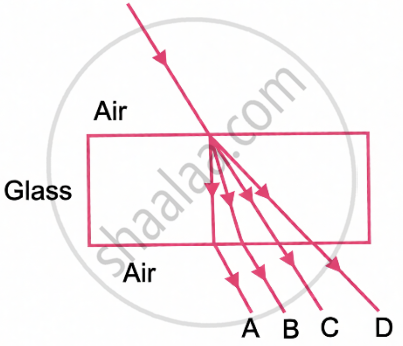
Make the correct for each of the following :
With reference to the fig, the refractive index of the glass block is
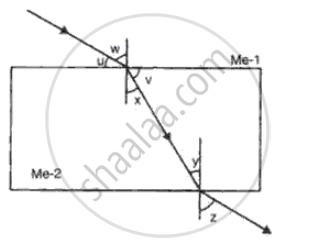
What is meant by the refraction of light?
A fish swimming in a pond seems nearer than it really is. Explain.
Write a relation between the angle of incidence (i), angle of emergence (e), angle of the prism (A), and angle of deviation (d) for a ray of light passing through an equilateral prism.
What do you understand by the deviation produced by a prism?
In the diagram below, PQ is a ray of light incident on a rectangular glass block.

How are the angles ‘i’ and ‘e’ related to each other?
Draw a diagram to show the refraction of a monochromatic light ray through an equilateral prism. On the diagram, label the incident, refracted, and emergent rays. It also indicates the angle of deviation by the letter δ.
The diagram shows the path of a ray of light through a rectangular glass block placed in a liquid of uniform density.

What should be the rate of the speed of light through the liquid to the speed through the glass so that there is no refraction of light at the boundaries of the glass block when the system is illuminated by the light of one colour?
A ray of light is incident at an angle of 45° on one face of a rectangular glass slab of thickness 10 cm and refractive index 3/2. Calculate the lateral shift produced ______.
Observe the figure and name the ray AB, ray CD, ray GH.

