Advertisements
Advertisements
प्रश्न
What do you understand by the deviation produced by a prism?
Advertisements
उत्तर
When a ray of light passes through a prism, it bends towards the base of the prism. Thus, the path of the emergent ray differs from the path of the incident ray. This is called the deviation produced by a prism.
संबंधित प्रश्न
In your laboratory you trace the path of light rays through a glass slab for different values of angle of incidence (∠i) and in each case measure the values of the corresponding angle of refraction (∠r) and angle of emergence (∠e). On the basis of your observations your correct conclusion is:
(a) ∠i is more than ∠r, but nearly equal to ∠e
(b) ∠i is less then ∠r, but nearly equal to ∠e
(c) ∠i is more than ∠e, but nearly equal to ∠r
(d) ∠i is less than ∠e, but nearly equal to ∠r
State the dependence of angle of deviation on the refractive index of the material of the prism.
With the help of diagram of the principal section of a prism, indicate its refracting surfaces, refracting edge and base.
The refractive index of glass is 1.5. From a point P inside a glass block, draw rays PA, PB and PC incident on the glass air surface at an angle of incidence 30°, 42° and 60° respectively.
- In the diagram show the approximate direction of these rays as they emerge out of the block.
- What is the angle of refraction for the ray PB?
`("Take" sin 42° =2/3)`
Four students A, B, C and D traced the paths of incident ray and the emergent ray by fixing pins P and Q for incident ray and pins R and S for emergent ray for a ray of light passing through a glass slab.

The correct emergent ray was traced by the student:
(1) A
(2) B
(3) C
(4) D
Which colour of light travels fastest in any medium except air?
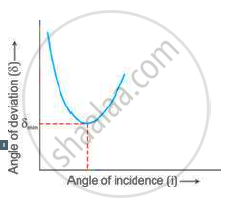
Using the curve, how do you infer that for given prism, the angle of minimum deviation δmin is unique for the given light?
A glass slab is placed over a page on which the word VIBGYOR is printed with each letter in its corresponding colour.
- Will the image of all the letters be in the same place?
- If not, the state which letter will be raised to the maximum. Give a reason for your answer.
Name the material for which the refractive index is found to be maximum.
Comment on the statement ‘The refractive index of glass is 3/2.’
