Advertisements
Advertisements
प्रश्न
Name the material for which the refractive index is found to be maximum.
Advertisements
उत्तर
The refractive index is maximum for the diamond, i. e., for a diamond the refractive index, μ = 2.418.
संबंधित प्रश्न
What is a spectrum?
Write a relationship between the angle of incidence and angle of refractions for a given pair of media.
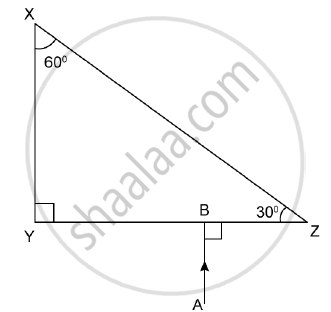
The following diagram shows a 60°, 30°, 90° glass prism of critical angle 42°, Copy the diagram and complete the path of incident ray AB emerging out of the prism marking the angle of incidence on each surface.
Observe the following figure and answer the questions given under it:

1) How many times does refraction take place in the above figure?
2) What happens to the ray of light when it passes from air to glass?
3) What happens to the ray of light when it passes from glass to air?
4) What are the rays AB and CD in the figure called?
5) Define refraction.
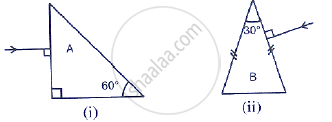
Fig 4.31 below shows a light ray of single colour incident normally on two prisms A and B. In each case draw the path of the ray of light as it enters and emerges out of the prism. Mark the angle wherever necessary.
Fill in the blank to complete the following sentence:
When light travels from a rarer to a denser medium, it bends ...........
Why upper surface of water contained in a beaker and above eye level appears silvery?
Name one main factor on which the direction of bending of a ray of light depends.
