Advertisements
Advertisements
प्रश्न
What is a spectrum?
Advertisements
उत्तर
The band of colored components of a beam of light is called a spectrum.
APPEARS IN
संबंधित प्रश्न
In your laboratory you trace the path of light rays through a glass slab for different values of angle of incidence (∠i) and in each case measure the values of the corresponding angle of refraction (∠r) and angle of emergence (∠e). On the basis of your observations your correct conclusion is:
(a) ∠i is more than ∠r, but nearly equal to ∠e
(b) ∠i is less then ∠r, but nearly equal to ∠e
(c) ∠i is more than ∠e, but nearly equal to ∠r
(d) ∠i is less than ∠e, but nearly equal to ∠r
Study the following four experimental set-ups I, II, III and IV for the experiment, "To trace the path of a ray of light through a rectangular glass slab."

Which of the marked set-ups is likely to give best results (P1 and P2 are the positions of pins fixed on the incident ray)?
(A) I
(B) II
(C) III
(D) IV
Draw diagrams to show the refraction of light from glass to air. In diagram, label the incident ray, refracted ray, the angle of incidence (i) and the angle of refraction (r).
When light travels from a rarer to a denser medium, its speed ______.
Fill in the blanks to complete the following sentence
The refractive index of glass with respect to air is 3/2. The refractive index of air with respect to glass will be ……………….
-
- the angle of refraction and
- the angle of deviation for the ray?
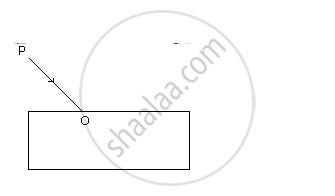
In the fig., PO is a ray of light incident on a rectangular glass block.
(a) Complete the path of the ray through the block.
(b) In the diagram, mark the angle of incidence (i) and the angle of refraction (r) at the first interface. How is the refractive index of glass related to the angles I and r?
(c) Mark angle of emergence by the letter e. How are the angles i and e related?
(d) Which two rays are parallel to each other? Name them.
(e) Indicate in the diagram the lateral displacement between the emergent ray and the incident ray.
What should be the ratio of the speed of light through the liquid to the speed through the glass so that there is no refraction of light at the boundaries of the glass block when the system is illuminated by the light of one colour?
What do you understand by the deviation produced by a prism?
The refractive index of air with respect to glass is defined: as gµa = sin i/sin r
Write down a similar expression for aµg in terms of angle i and r.
Draw ray of light bending towards the normal while passing from air to glass. Label your diagrams.
Draw ray of light bending towards the normal while passing from glass to water. Label your diagrams.
How will you verify the laws of refraction or how the refractive index of glass is determined in the laboratory?
A ray of light PQ is incident normally on the hypotenuse of a right-angled prism ABC as shown in the diagram given below:

(i) Copy the diagram and complete the path of the ray PQ till it emerges from the prism.
(ii) What is the value of the angle of deviation of the ray?
(iii) Name an instrument where this action of the prism is used.
The speed of light in air is 3 × 10⁸ ms-1. Calculate the speed of light in water. The refractive index of water is 4/3.
The velocity of light in diamond is 121000 kms-1. What is its refractive index?
