Advertisements
Advertisements
प्रश्न
Draw a diagram to show the refraction of a monochromatic light ray through an equilateral prism. On the diagram, label the incident, refracted, and emergent rays. It also indicates the angle of deviation by the letter δ.
Advertisements
उत्तर
The labelled diagram is given below:

संबंधित प्रश्न
A student traces the path of a ray of light passing through a rectangular glass slab and marks the angle of incidence i, angle of refraction r and angle of emergence e, as shown.
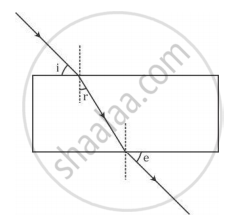
The correctly marked angle(s) is/are
(A) ∠ i only
(B) ∠ e only
(C) ∠ r only
(D) ∠ i and ∠ e
When a lighted candle is held in front of a thick plane glass mirror, several images can be seen, but the second image is the brightest, give reason.
A ray of light of wavelength 6600 Å suffer refraction from air to glass. Taking \[\ce{_a\mu_g = \frac{3}{2}}\], find the wavelength of light in glass.
-
- the angle of refraction and
- the angle of deviation for the ray?
A ray of light strikes the surface at a rectangular glass slab such that the angle of incidence is 45o.
In each case, draw diagram to show the path taken by the ray as it passes through the glass slab and emerges from it.
Name two instruments of the total refracting prism in which is used.
Trace a ray of light incident at 30° on a surface if travelling from glass to air. What is the angle of refraction in this case? (R.I. for glass = 3/2).
The velocity of light in diamond is 121000 kms-1. What is its refractive index?
What is lateral displacement?
