Advertisements
Advertisements
प्रश्न
Draw a diagram to show the refraction of a monochromatic light ray through an equilateral prism. On the diagram, label the incident, refracted, and emergent rays. It also indicates the angle of deviation by the letter δ.
Advertisements
उत्तर
The labelled diagram is given below:

संबंधित प्रश्न
What is a spectrum?
Draw a ray diagram to show the refraction of a monochromatic ray through a prism when it suffers minimum deviation.
A ray of light of wavelength 6600 Å suffer refraction from air to glass. Taking \[\ce{_a\mu_g = \frac{3}{2}}\], find the wavelength of light in glass.
A total reflecting right angled isosceles prism can be used to deviate a ray of light through:
(a) 30° (b) 60° (c) 75° (d) 90°.
Four students showed the following traces of the path of a ray of light passing through a rectangular glass slab.

The trace most likely to be correct is that of student
(A) I
(B) II
(C) III
(D) IV
Define the term refractive index of a medium. What do you understand by the statement 'the refractive index of glass is 1.5 for white light'?
Fig shows a lens as a combination of a glass block and two prisms.
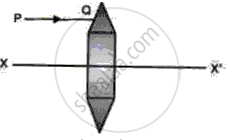
(i) Name the lens formed by the combination.
(ii) what is the XX' called?
(iii) Complete the ray diagram and show the path of the incident ray PQ after passing through the lens.
(iv) The final emergent ray will either meet XX' at a point or appear to come from a point on XX'. what is the point called?
A ray of light passes from water to air. How does the speed of light change?
A ray of light moves from a rare medium to a dense medium as shown in the diagram below. Write down the number of the ray which represents the partially reflected ray.

The diagram shows the path of a ray of light through a rectangular glass block placed in a liquid of uniform density.

What should be the rate of the speed of light through the liquid to the speed through the glass so that there is no refraction of light at the boundaries of the glass block when the system is illuminated by the light of one colour?
