Advertisements
Advertisements
प्रश्न
The critical angle for glass-air is 45° for the light of yellow colour. State whether it will be less than, equal to, or more than 45° for (i) ref light, (ii) blue light?
Advertisements
उत्तर
As the wavelength decreases (or increases) refractive index becomes more (or less) and critical angle becomes less (or more).
(i) For red light the critical angle will be more than 45° and
(ii) For blue light the critical angle will be less than 45°.
संबंधित प्रश्न
State the dependence of angle of deviation on the wavelength of light
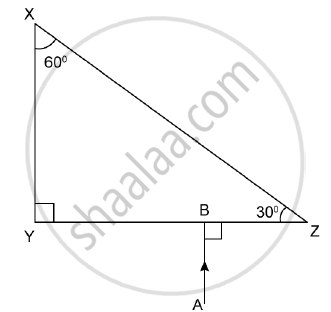
The following diagram shows a 60°, 30°, 90° glass prism of critical angle 42°, Copy the diagram and complete the path of incident ray AB emerging out of the prism marking the angle of incidence on each surface.
How is the refractive index of a medium related to the speed of light in it?
How does the angle of minimum deviation produces by a prism change with increase in :
the refracting angle of prism?
What do you understand by the statement the refractive index of glass is 1.5 for white light?
(i) What is the relation between the refractive index of water with respect to air `("_aμ_\text(w))` and the refractive index of air with respect to water `("_\text(w)μ_ a)` .
(ii) If the refractive index of water with respect to air `("_aμ_\text(w))` is`5/3`. Calculate the refractive index of air with respect to water `("_\text(w)μ_ a)` .
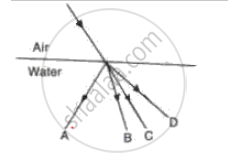
A ray of light passes from air to water. In fig. 39, which of the ray A, B, C and D is the correct refracted ray?
Does the depth of a tank of water appear to change or remain the same when viewed normally from above?
What should be the ratio of the speed of light through the liquid to the speed through the glass so that there is no refraction of light at the boundaries of the glass block when the system is illuminated by the light of one colour?
The diagram shows the path of a ray of light through a rectangular glass block placed in a liquid of uniform density.

Show with the help of a ray diagram the path of the ray when incident ray normally falls on the first surface of the glass block and passes through the block and the liquid.
