Advertisements
Advertisements
Question
The critical angle for glass-air is 45° for the light of yellow colour. State whether it will be less than, equal to, or more than 45° for (i) ref light, (ii) blue light?
Advertisements
Solution
As the wavelength decreases (or increases) refractive index becomes more (or less) and critical angle becomes less (or more).
(i) For red light the critical angle will be more than 45° and
(ii) For blue light the critical angle will be less than 45°.
RELATED QUESTIONS
Explain how the formation of a rainbow occurs.
A ray of light passes from water to air. How does the speed of light change?
Name a prism required for obtaining a spectrum of Ultraviolet light.
When a ray of light from air enters a denser medium, it ______.
A total reflecting right angled isosceles prism can be used to deviate a ray of light through:
(a) 30° (b) 60° (c) 75° (d) 90°.
A student has traced the path of a ray of light through a glass slab as follows. If you are asked to label 1, 2, 3 and 4, the correct sequencing of labeling ∠i, ∠e, ∠r and lateral displacement respectively is
(a) 2, 1, 3, 4
(b) 1, 2, 3, 4
(c) 1, 3, 2, 4
(d) 1, 3, 4, 2
“A ray of light incident on a rectangular glass slab immersed in any medium emerges parallel to itself.” Draw labelled ray diagram to justify the statement.
Fig shows a lens as a combination of a glass block and two prisms.
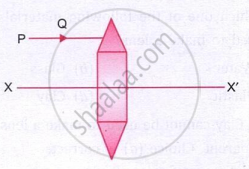
- Name the lens formed by the combination.
- What is the line XX' called?
- Complete the path of the incident ray PQ after passing through the lens.
- The final emergent ray either meets XX' at a point or appears to come from a point on XX'. Label it as F, What is this point called?
Draw a ray diagram showing the lateral displacement of a ray of light when it passes through a parallel sided glass slab.
What is the refractive index of water
