Advertisements
Advertisements
Question
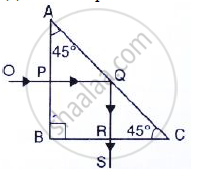
A ray of light OP passes through a right angles prism as shown in the adjacent diagram.
(a) State the angles of incidence at the faces AC and BC.
(b) Name the phenomenon which the ray suffers at the face AC.
Advertisements
Solution
(a) The angle of incidence at the face AC is 45° and angle of incidence at the face BC is 0°.
(b) The ray suffers total internal reflection at the face AC.
RELATED QUESTIONS
If the speed of light in vacuum is 3 × 10⁸ ms−1, find the speed of light in a medium of absolute refractive index 1.5.
Draw diagrams to show the refraction of light from
- air to glass, and
- glass to air. In each diagram, label the incident ray, refracted ray, the angle of incidence
- and the angle of refraction (r).
A monochromatic ray of light passes from air to glass. The wavelength of light in air is λ, the speed of light in air is c and in glass is V. If the absolute refractive index of glass is 1.5, write down
- the relationship between c and V,
- the wavelength of light in glass.
“A ray of light incident on a rectangular glass slab immersed in any medium emerges parallel to itself.” Draw labelled ray diagram to justify the statement.
Rahim recorded the following sets of observations while tracing the path of a ray of light passing through a rectangular glass slab for different angles of incidence.
|
S. No. |
Angle of incidence |
Angle of refraction |
Angle of emergence |
|
I |
45° |
41° |
45° |
|
II |
40° |
38° |
38° |
|
III |
45° |
41° |
40° |
|
IV |
41° |
45° |
41° |
The correct observation is recorded at serial number:
(1) I
(2) II
(3) III
(4) IV
In an experiment of finding the refractive index of glass, if blue light is replaced by the red light, how will the refractive index of glass change? Give reason in support of your answer.
Name one main factor on which the direction of bending of a ray of light depends.
Define the term refractive index of a medium in terms of velocity of light.
You are provided with a printed piece of paper. Using this paper how will you differentiate between a convex lens and a concave lens?
Which colour of white light travels fastest in any medium except air?
